Key Takeaways for Senior Executives
-
-
- The composites revolution is accelerating driven by aerospace, defense, and energy transitions but most firms are underprepared for the cost and scalability challenges ahead.
- Winners will separate from losers in the next 3 to 5 years based on three strategic bets:
- Partnerships with OEMs in aerospace/EVs
- Breakthroughs in low-cost carbon fiber
- Closed-loop recycling solutions
- Margins are at risk unless production shifts toward automated, and large-scale manufacturing.
-
The Strategic Landscape: Where Are the Real Pockets of Growth?
1. Aerospace & Defense: The High-Stakes Game
-
-
- Boeing and Airbus now allocate 50%+ of material budgets to composites, up from 30% a decade ago.
- Critical vulnerability: Only 4 suppliers control 80% of aerospace-grade carbon fiber. If you’re not locked into long-term contracts with Hexcel or Toray, you’re already behind.
-
Our Recommendation:
-
-
- For Tier 1 suppliers: Secure multi-year offtake agreements now as spot market pricing is volatile.
- For new entrants: Target UAVs and regional jets where certification barriers are lower.
-
Strategic positioning of key players in aerospace composites
|
Company |
Key Advantage |
|
Hexcel |
Airbus sole-source contracts |
|
Teijin |
Military UAV dominance |
|
Solvay |
Engine components leadership |
2. Automotive: The Coming Inflection Point
The Reality Check:
-
-
- While carbon fiber use in EVs grows at 18% CAGR, most automakers will not pay a >15% premium over aluminum.
- Tesla’s Cybertruck bet on ultra-hard stainless steel signals lingering cost skepticism.
-
Winning Moves:
-
-
- Hybrid material systems (e.g., carbon fiber + aluminum joints) for structural components.
- Pre-competitive collaboration – like Tata AutoComp Systems Ltd. and Katcon Global JV.
-
The Make-or-Break Challenges Most Boards Are Underestimating
1. The Precursor Problem
-
-
- 95% of carbon fiber relies on PAN precursor, with major control by Japan.
- Geopolitical risk: A Taiwan conflict could disrupt over 30% of global supply within weeks.
-
Strategic Response Required:
-
-
- Alternative precursors (lignin, textile waste) need 5-10x more R&D funding than currently allocated.
-
2. The Recycling Time Bomb
-
-
- By 2027, EU regulations may mandate over 50% recyclability in composites – today’s solutions achieve <30%.
- First-mover advantage: Companies are developing and protecting their proprietary pyrolysis technologies.
-
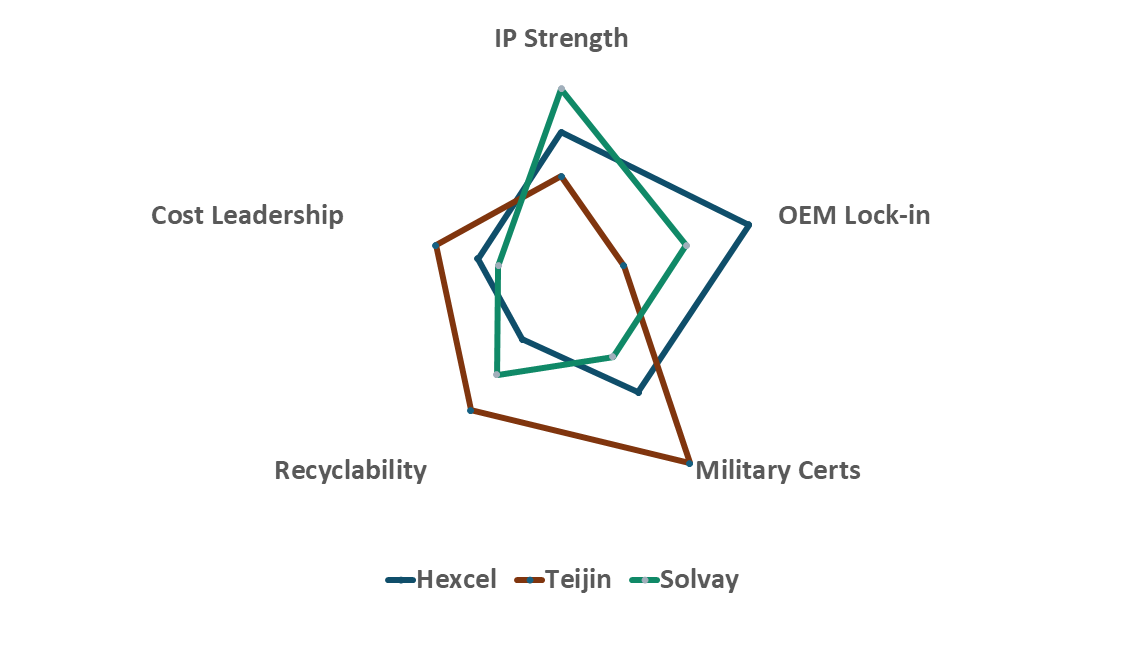
Aerospace Composites Competitive Moats
Emerging Threat: The China Factor in Composite Material Dominance
China is rapidly closing the technology gap in advanced composites, leveraging state-backed investments and aggressive IP acquisition. Consider these critical developments:
1. Military-Civil Fusion Strategy
-
-
- AVIC’s new CFRP plant in Chengdu will produce 12,000 MT/year of aerospace-grade carbon fiber which is enough to supply majority of China’s fighter jet demand.
- Export controls evasion: Chinese firms are acquiring European pyrolysis tech via shell companies.
-
2. Cost Warfare Tactics
-
-
- State-subsidized dumping: A Chinese supplier’s PAN precursor is priced ~ 30% below market.
- Forced IP transfer: COMAC’s supplier contracts mandate tech sharing with domestic partners.
-
Strategic Responses Required
-
-
- Defense contractors: Audit Tier 2+ suppliers for undisclosed Chinese material inputs.
- Material producers: Lobby for CFIUS blocks on Chinese acquisitions of recycling IP.
- Automakers: Preempt EU anti-dumping duties by diversifying beyond China-dependent precursors.
-
China isn’t just competing, it’s rewriting the global rules. Ignoring this risks strategic dependency by 2030.
Three Non-Negotiable Actions for Leadership Teams
1. Reshape Your Supply Chain Now
-
-
- Dual-source precursors: South Korea’s Hyosung now offers PAN at lower cost than Japanese incumbents. Hyosung has invested heavily to expand carbon fiber production capacity with annual output to 24,000 tons by 2028.
- Onshore/nearshore production
-
2. Force the Cost Curve Down
-
-
- Robotic automated fiber placement (AFP) reduces labor costs by 50% in wing production.
- Alternative chemistries: Arkema’s Elium resin enables 30% faster curing vs. epoxies.
-
3. Play the Sustainability Card Harder
-
-
- Bio-based epoxy resins already command 12% price premiums in EU tenders.
- Waste-to-fiber partnerships: HRC and Airbus Lifecycle Services Center (ALSC) collaborated to increase material recovery, and lessen environmental impact for an aircraft dismantling and recycling project.
-
Conclusion: The Composites Revolution Demands Action Now
The advanced composites market is no longer about incremental innovation but it’s a high-stakes reconfiguration of global supply chains, defense readiness, and sustainable manufacturing. Here’s what leadership teams must internalize:
The New Rules of Competition
-
-
- Recyclability is no longer optional – EU and other mandates will blacklist non-compliant suppliers by 2027.
- Dual-sourcing is existential – Hyosung’s PAN discount proves Asia’s cost dominance, but geopolitical risks demand redundancy.
- Military contracts now hinge on circularity
-
The Cost of Inaction
-
-
- Margin erosion: Firms relying on virgin carbon fiber face over 30% cost penalties vs. recyclers.
- Obsolescence risk: Traditional epoxy formulations won’t qualify for next-gen aerospace/EV programs.
- Shareholder backlash: ESG funds are divesting from linear material producers.
-