Executive Summary
-
- Port automation is deepening in a small set of mega-hubs rather than spreading evenly. Singapore’s Tuas Port and China’s 60 automated container terminals set the global reference points for scale.
- Throughput gains are real but conditional. The ports that lead the World Bank’s efficiency index pair automated equipment with tightly orchestrated berth, yard, gate and rail processes.
- In United States, a dockworker contract that runs to 2030, a 25% tariff on Chinese ship-to-shore cranes and a suspended 100% surcharge that lapses on 9 November 2026 make automation a policy question as much as an engineering one.
- Ownership is consolidating around carrier-backed terminal groups. MSC’s terminal arm alone is party to the Hamburg, Panama and Vizhinjam transactions, while the CK Hutchison portfolio sale remains unresolved.
- Resilience now includes cyber compliance and sovereign concession risk, both of which should be priced into automation business cases alongside capex and productivity.
Scale, Not Spread: Where Port Automation is Heading in 2026
For most of the past two decades, automated container terminals were showcase projects. In 2026 they have become the operating standard for a specific class of asset: deep-water transshipment and gateway hubs that handle ultra-large vessels, run around the clock and cannot add land easily. Elsewhere, the business case remains contested, shaped by labour agreements, equipment costs and the maturity of the surrounding logistics chain.
This distinction matters for strategy. Terminal automation is not a single technology decision. It is a combination of three layers that must be designed together: the automated equipment itself (ship-to-shore cranes, stacking cranes, horizontal transport), the terminal operating and equipment control software that sequences every move, and the wider port orchestration that links berth windows, gates, rail, customs and hinterland partners. Returns are decided by how well those layers fit, not by the size of the crane order.
Asia-Pacific: The Global Benchmarks for Automated Terminals
Singapore: Tuas Port and The Logic of a Single Automated Hub
Singapore’s Tuas Port is the clearest expression of automation as national infrastructure strategy. When complete in the 2040s, it is designed for 65 million TEU of annual capacity across 66 berths and 26 km of quay, consolidating PSA’s city terminals onto one site. The port opened in September 2022 with three berths and has since handled a cumulative 25 million TEU. It currently runs 14 berths and is scheduled to reach 18 by 2027.
Two recent details are instructive for operators planning their own programmes. First, PSA took delivery of the final automated rail-mounted gantry cranes for Phase 1 in August 2026, completing a six-year programme that brought the Phase 1 fleet to 208 units, all supplied by ZPMC. Second, PSA is changing yard geometry for Phase 2, orienting stacking blocks parallel to the quay rather than perpendicular to it, with the first Phase 2 berth expected in 2028. MPA began handing reclaimed Phase 2 land to PSA in 2026. A leading operator revising its layout mid-programme is a reminder that automation design should be treated as iterative, with operating data from early phases feeding later ones.
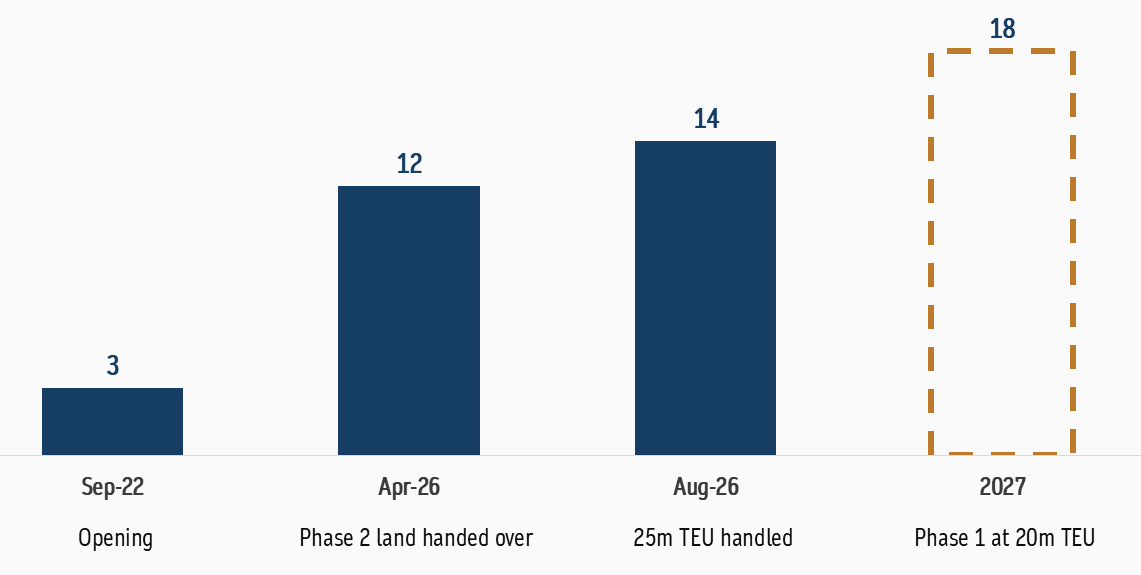
Tuas Port operational berths, 2022 to 2027
China: Automation As an Industrial Standard
China has moved from pilots to standardization. The Ministry of Transport reported in October 2025 that the country has built 60 automated container terminals, and that national container throughput reached about 230 million TEU in the first eight months of that year, up 6.3%. National design specifications for automated container and bulk terminals have been issued, which lowers delivery risk for new builds and supports exports of Chinese automation solutions to overseas projects.
Qingdao’s fully automated terminal, built in three phases from 2015 with the third operational by end-2023, illustrates the operating upside: the port reports a 6% efficiency gain, a 15% throughput increase and an average single-crane rate of 60.9 moves per hour recorded on 1 January 2025. For international buyers, the implication cuts both ways. Chinese suppliers offer proven, integrated equipment at scale, yet that same dominance is now the focus of trade and security policy in the United States.
India: Greenfield Transshipment with Automation Built In
India’s most visible automation play is Vizhinjam in Kerala, developed by Adani Ports and SEZ (APSEZ). In January 2026 the port recorded a monthly high of 123,092 TEU across 62 vessel calls and a best gross crane rate of 30.12 moves per hour, while also deploying India’s first women automated crane operators. APSEZ has announced a Rs 16,000 crore Phase 2 that includes 21 automated ship-to-shore cranes and 45 automated cantilever rail-mounted gantry cranes, alongside a 920-metre breakwater extension at 21 metres depth. Beyond Vizhinjam, Jawaharlal Nehru Port’s steady rise in the World Bank index, discussed below, shows that capacity additions and process reform can lift performance at established gateways too.
What Performance Data Shows About Throughput and Resilience
The World Bank and S&P Global Market Intelligence Container Port Performance Index (CPPI) measures the total time vessels spend in port, making it one of the few neutral, cross-country gauges of terminal efficiency. The fifth edition, covering 2020 to 2024 and 403 ports, found that global performance declined across the period amid the Red Sea crisis, Panama Canal constraints and pandemic after-effects, while East Asian ports held 15 of the top 20 places. Shanghai’s Yangshan, a flagship automated terminal, ranked first for the third consecutive year.
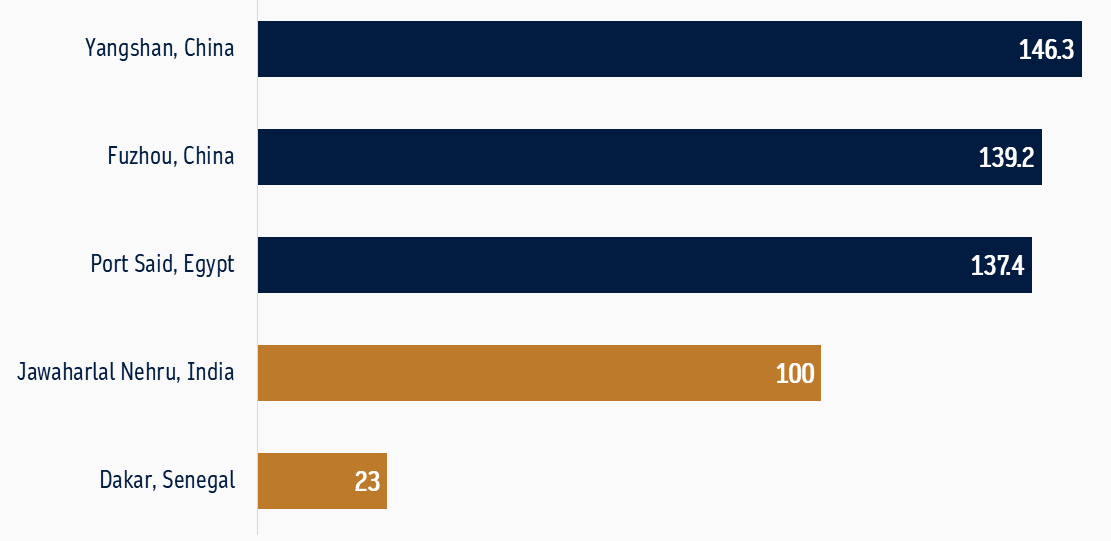
Container Port Performance Index scores, selected ports, 2024
Two lessons stand out. The leaders combine automation with volume density and disciplined berth planning, so automation acts as a multiplier rather than a substitute for operating fundamentals. Dakar, operated by DP World since 2008, moved from a score of -82 in 2023 to 23 in 2024, which the report links to infrastructure investment and a digital port community system connecting stakeholders. For many emerging-market gateways, orchestration and digitalization deliver faster resilience returns than full equipment automation.
North America: Labour, Tariffs and The Crane Supply Chain
A Labour Settlement That Sets The Pace To 2030
On U.S. East and Gulf Coasts, the International Longshoremen’s Association (ILA) ratified a six-year master contract with U.S. Maritime Alliance (USMX) running to 30 September 2030, with nearly 99% approval. The union highlights a 62% wage increase and protections against automation. Automation was the central sticking point of the talks, with the union at one stage breaking off negotiations over rail-mounted gantry cranes at the ports of Virginia and New York and New Jersey. The agreement covers around 25,000 workers across 14 ports.
The practical consequence is that fully automated greenfield terminals are unlikely on these coasts this decade. Investment is better directed to technology that the contract framework can accommodate remote-assisted equipment, gate and yard digitalization, predictive maintenance and data integration with rail and trucking partners.
Ship-To-Shore Cranes Become a Trade Policy Instrument
Crane procurement now carries material tariff exposure. A 25% Section 301 duty on Chinese ship-to-shore cranes applies following the 2024 four-year review, with a carve-out for units ordered before 14 May 2024 and imported before 14 May 2026. In October 2025, U.S. Trade Representative announced additional duties of 100% on Chinese ship-to-shore cranes and certain cargo handling equipment. Following the US-China trade arrangement of November 2025, the responsive actions in that investigation were suspended from 10 November 2025 through 9 November 2026. With that window closing in under two months, any port with open crane tenders should be modelling both an extension and a lapse.
Alternative supply is developing but slowly. Konecranes has built a network of U.S. partners to produce port cranes, including ship-to-shore units, that comply with Build America, Buy America requirements. Mitsui E&S subsidiary PACECO won an order in September 2025 for two ship-to-shore cranes for a Long Beach terminal, to be built in Japan with U.S.-supplied components. Yet the Philadelphia port authority stated in February 2026 that it could not source electric cranes manufactured in America. The market is shifting, but lead times and cost premiums remain significant.
Europe: Carrier Capital and The Brownfield Automation Path
Europe’s automation story is increasingly about upgrading existing terminals with carrier capital. In Hamburg, MSC completed its entry into HHLA in 2024, creating a joint venture in which the City holds 50.1% and MSC 49.9%. The partners committed EUR 450 million in equity for HHLA’s investment needs, and MSC pledged at least 1 million TEU a year through HHLA terminals from 2031. HHLA’s Container Terminal Altenwerder, a 2002 greenfield pioneer, runs a fleet of about 80 battery-powered automated guided vehicles, and its next phase of ship-to-shore crane automation was under way when WorldCargo News visited in May 2026.
In Rotterdam, APM Terminals Maasvlakte II opened with eight fully automated electric ship-to-shore cranes and 2.7 million TEU of initial capacity, with a planned build-out to 4.5 million TEU. The port authority and APM Terminals agreed in 2023 on a roughly EUR 1 billion expansion adding 2 million TEU, while Rotterdam World Gateway announced its own expansion of 1.8 million TEU. The European pattern is instructive for mature ports everywhere: phased automation within live operations, backed by long-term volume commitments from carrier shareholders.
Middle East and Africa: Capacity Races and Hub Ambitions
The Gulf is using joint ventures to add automated capacity quickly. At Abu Dhabi’s Khalifa Port, the first semi-automated container port in the GCC, CMA Terminals Khalifa Port (70% CMA CGM, 30% AD Ports) reached 87% utilization within its first year. The partners committed AED 420 million to lift capacity from 1.8 to 2.7 million TEU by early 2028, taking Khalifa Port to about 10.5 million TEU. AD Ports also took a 20% stake in Syria’s Latakia International Container Terminal alongside CMA CGM, an example of Gulf operators exporting their operating model.
In Africa, Morocco’s Tanger Med, operating highly automated terminals, handled about 11.1 million TEU in 2025, while Nigeria’s Lekki Deep Sea Port was designed as a fully automated, round-the-clock operation with 2.5 million TEU of capacity and a 16.5-metre draught. Investment momentum is strong: MSC signed a 45-year concession in March 2026 for a dedicated container terminal at Snake Island Port in Lagos, and Hapag-Lloyd has deepened its terminal partnership with DP World as it expects African volumes to exceed 1 million TEU in 2026. The constraint is less the quay than the corridor. Customs, rail and barge links determine whether automated berths translate into faster cargo release.
M&A, Joint Ventures and Concessions Reshaping Port Ownership
Automation is capital intensive, and the capital increasingly comes from container carriers seeking control over their network nodes. The most consequential live transactions are summarized below.
| Transaction | Parties | Key terms | Status |
| Global ports portfolio sale (43 ports, 23 countries) | CK Hutchison; consortium of BlackRock and MSC’s TiL; COSCO invited | Enterprise value of USD 22.8 billion for the 80% holding | Stalled under Chinese regulatory pressure; China Merchants reportedly joined talks in April 2026 |
| Balboa and Cristobal terminals, Panama | Government of Panama; APM Terminals; TiL | Concession annulled by Supreme Court; 18-month interim operation, then international tender | Interim operations since 23 February 2026; CK Hutchison pursuing arbitration |
| Vizhinjam International Seaport, India | APSEZ; TiL | 49% stake for USD 1.397 billion, including USD 539 million upfront | Announced 30 June 2026; Kerala government states its approval is required |
| HHLA, Hamburg | City of Hamburg; MSC | 50.1% / 49.9% JV; EUR 450 million equity; 1 million TEU a year from 2031 | Completed November 2024 |
| CMA Terminals Khalifa Port expansion | CMA CGM; AD Ports | AED 420 million for +0.9 million TEU | Completion targeted early 2028 |
The Panama case deserves particular attention from any investor in concession-based assets. Panama’s Supreme Court invalidated the legal framework behind CK Hutchison’s concession in January 2026, and the government appointed US subsidiaries of APM Terminals and TiL as interim operators. The two terminals handle roughly 3.8 million TEU a year, close to 40% of Panama’s container throughput, and the government took possession of terminal assets including cranes and IT systems. As of mid-September 2026, the temporary arrangements remain in place while a new concession process is prepared. Automated equipment and terminal software are only as secure as the legal title under which they operate.
The Vizhinjam transaction offers a contrasting template. APSEZ values the asset at about USD 2.85 billion, retains 51% and control, and uses the carrier’s contribution to fund expansion while securing volume, a structure that monetizes a greenfield hub without surrendering operations. Political scrutiny of carrier concentration, as voiced in Kerala, is likely to follow similar deals elsewhere.
Orchestration and Cyber: The Layer That Decides Returns
An automated stacking crane that waits for a late truck or a mistimed rail slot delivers little of its rated productivity. Orchestration, meaning the integration of the terminal operating system, equipment control, berth planning, appointment systems and port community platforms, is where throughput is protected when disruption hits. Tuas’s Phase 2 layout change and Dakar’s index gains both point the same way: design and data flows matter as much as hardware.
Orchestration also concentrates cyber risk. In United States, the Coast Guard’s cybersecurity rule for the Marine Transportation System took effect on 16 July 2025. Covered facilities must designate a Cybersecurity Officer, complete a cybersecurity assessment and submit a Cybersecurity Plan for approval by 16 July 2027, with annual personnel training already required. Automated terminals, with their dense operational technology estates and remote access pathways, should treat this as a design input rather than a compliance afterthought. Operators outside the U.S. face comparable expectations from regulators, insurers and carrier customers.
Upcoming Milestones for Port Automation Stakeholders, 2026 To 2031
| Date | Milestone | Why it matters |
| 9 Nov 2026 | Suspension of U.S. Section 301 maritime actions, including the 100% crane surcharge, ends unless extended | Crane and cargo-handling equipment pricing for U.S. projects |
| 2027 | Tuas Port reaches 18 berths | Phase 1 approaches 20 million TEU design capacity |
| 16 Jul 2027 | U.S. Coast Guard cyber plan, assessment and officer deadlines | Compliance gate for automated U.S. facilities |
| Aug 2027 (approx.) | End of Panama’s 18-month interim operating period | International tender for Balboa and Cristobal concessions |
| Early 2028 | Khalifa Port CMA terminal expansion to 2.7 million TEU | Gulf transshipment capacity and competition |
| 2028 | First Tuas Phase 2 berth; Vizhinjam expansion target (December) | New automated capacity on Asia-Europe routes |
| 30 Sep 2030 | ILA-USMX master contract expires | Next window for U.S. East and Gulf Coast automation terms |
| 2031 | MSC minimum volume commitment at HHLA begins | Utilization underpinning Hamburg automation investment |
Strategic Imperatives for Port Boards and Investors
-
- Build the business case on orchestrated throughput, not equipment specifications. Model productivity at the level of berth, yard, gate and rail together, and stress-test the case against disruption scenarios, not just steady-state volumes.
- Treat crane sourcing as a geopolitical supply chain. Run tariff scenarios around the November 2026 deadline, qualify at least two suppliers, and evaluate control-system and software provenance separately from steel structures.
- Match automation depth to the labour and regulatory context. Where full automation is constrained, as on the US East and Gulf Coasts to 2030, prioritize remote-assisted operations, digital gates and data integration, and plan workforce transition with the same rigor as capex.
- Secure volume before capacity. The strongest recent deals, from Hamburg to Vizhinjam to Khalifa, pair automated capacity with carrier commitments. Investors should examine the tenor and enforceability of those commitments closely.
- Price sovereign and concession risk explicitly. Panama shows that legal title can change quickly. Due diligence should cover concession law, arbitration protections and asset step-in rights for automated equipment and IT.
- Make cyber resilience part of the design basis. Segment operational technology, govern remote vendor access and align with regulatory deadlines such as U.S. July 2027 milestone from day one.