The regulatory perimeter for stablecoin payment infrastructure has been drawn, and drawing it has restructured the industry. The United States GENIUS Act, Hong Kong’s Stablecoins Ordinance and the European Union’s MiCA regime have each converted stablecoin issuance from an unlicensed activity into a supervised one. That has had a predictable consequence: capability is consolidating into balance sheets that can carry regulatory capital, reserve obligations and audited attestations. Hong Kong received 36 license applications and granted two.
Institutional commitment is now measurable in capital, not press releases. Mastercard agreed in March 2026 to acquire the stablecoin payments company BVNK for up to USD 1.8 billion. Visa’s settlement pilot reached a USD 7 billion annualized run rate across nine blockchains by April. Circle reported USD 77.0 billion of USDC in circulation and USD 694 million of quarterly revenue and reserve income. In June, a consortium of more than 140 financial and commerce firms including Stripe, Visa, Mastercard, BNY, U.S. Bank and Shopify launched a jointly backed dollar token. The largest US banks are building a competing tokenized deposit network for 2027.
The Financial Stability Board’s Deputy Secretary General told an OMFIF audience on 8 July 2026 that against roughly USD 200 trillion of total cross-border payments in 2024, stablecoins accounted for less than 0.2 per cent of cross-border flows in 2025.
The value in this market has migrated from issuance to orchestration and the firms capturing it are the ones treating stablecoins as a settlement component inside existing treasury and payments architecture, rather than as a replacement for it.
Regulations for Stablecoin Payment
For most of the past decade, stablecoin issuance was defined by the absence of rules. That is no longer the case, and the shape of the rules is now determining the shape of the market.
In the United States, the GENIUS Act was signed on 18 July 2025. It establishes a federal license for permitted payment stablecoin issuers, designates the Office of the Comptroller of the Currency as primary regulator for federally licensed non-bank issuers, requires full reserve backing in a narrow menu of high-quality liquid assets, and mandates monthly reserve reporting. Issuers with more than USD 10 billion outstanding must sit under federal rather than state supervision.
Institutions are being asked to commit capital to a licensing regime whose operating requirements are still in draft. One consequential question remains genuinely unresolved: whether permitted issuers may pay yield. The FDIC’s prudential proposal would prohibit it. A White House Council of Economic Advisers analysis published on 8 April 2026 concluded that eliminating stablecoin yield would increase bank lending by only USD 2.1 billion, an increase of roughly 0.02 per cent. Banks and issuers are lobbying opposite sides of that question, and the answer will materially reprice the deposit-substitution risk that the entire sector is arguing about.
Elsewhere the perimeter is tighter and clearer. Hong Kong’s Stablecoins Ordinance took effect on 1 August 2025 with a HKD 25 million paid-up capital floor and full high-quality-liquid-asset reserve backing. The Hong Kong Monetary Authority received 36 formal applications by the September 2025 deadline and, on 10 April 2026, granted exactly two licenses: one to HSBC, one to Anchorpoint Financial, a joint venture of Standard Chartered Bank (Hong Kong), HKT and Animoca Brands. Both intend to launch Hong Kong dollar tokens in the second half of 2026.
A first-round approval rate near 6 per cent is not a processing bottleneck. It is a policy statement. The HKMA has signaled that bank-grade custody, reserve governance and consortium structure are the qualifying criteria and every applicant weighing a second filing should read the two approvals as a template rather than a queue.
In the European Union, MiCA achieved something its drafters intended and its critics underestimated. The requirement that authorized issuers hold 60 per cent of reserves in EU bank deposits proved incompatible with Tether’s Treasury-bill-weighted model, and USDT was progressively delisted across EU venues. The shelf space went to compliant issuers. The unintended consequence is that Europe’s regulated euro-token market is currently dominated by an American issuer, which is precisely the dependency European policymakers set out to avoid.
Stablecoins by Numbers
Total stablecoin capitalization stood near USD 303 billion in mid-July 2026, having grown from roughly USD 27 billion at the end of 2020 and USD 124 billion at the end of 2023. The market added approximately USD 75 billion in 2024 and USD 102 billion in 2025. Concentration remains extreme where USDT and USDC together account for over 80 per cent of supply.
What the growth curve does not show is that supply is currently falling. Aggregate capitalization declined by USD 7.7 billion in June 2026. It was the largest single-month contraction since the Terra collapse in May 2022 and by roughly USD 10 billion from its May peak. This is a liquidity effect, not a structural verdict. But it is a useful corrective to the assumption that stablecoin supply only compounds upward, and it arrived in the same quarter that produced the sector’s most bullish institutional announcements.
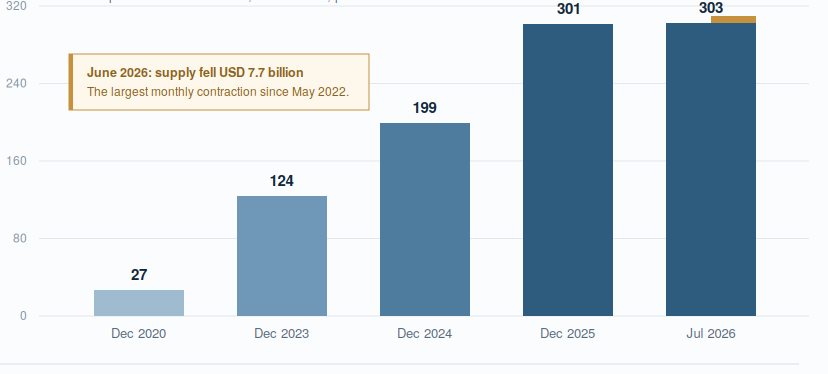
Total stablecoin capitalization in circulation, USD Billions
Estimates put real-world stablecoin payment volume for 2025 at roughly USD 390 to 400 billion, of which around 60 per cent was business-to-business. It is also approximately 0.2 per cent of global cross-border payment value.
Capital Flow Structure
1. Corporate Treasury: The Twenty-Four-Hour Balance Sheet
Treasury is the use case with the clearest internal logic, because it does not require anyone outside the enterprise to change behaviour. A treasurer moving liquidity between the group’s own entities across time zones is solving a self-contained problem: correspondent rails close, blockchain rails do not.
The evidence of institutionalization is in the integration layer rather than the token layer. Circle disclosed in its first-quarter 2026 results that Kyriba is embedding USDC capability directly into enterprise treasury management systems, allowing treasury teams to access continuous liquidity inside existing workflows, controls and approval hierarchies.
2. Cross-Border B2B: Corridor Economics Decide Everything
Traditional correspondent banking carries an all-in cost that is far above the headline wire fee once FX spread, intermediary deductions and lifting charges are counted. Firms that have migrated cross-border flows to stablecoin rails report average payment cost reductions of around 35%, rising to roughly 47% for those processing more than USD 100 million in monthly volume. Payroll and contractor payments are the most commonly cited entry point, followed by supplier payments and treasury movements.
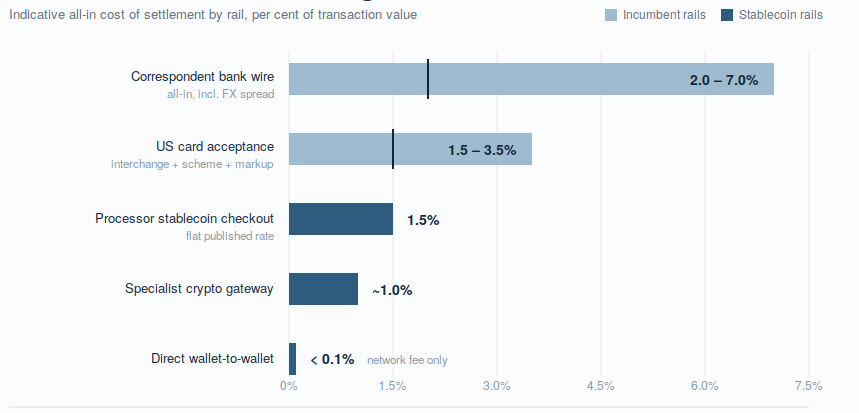
Indicative All-In Cost of Settlement by Rail, Per Cent of Transaction Value
Stablecoin liquidity is heavily concentrated. A majority of global liquidity sits in a handful of major trading pairs against the US dollar, euro and sterling. Converting into Indonesian rupiah, Nigerian naira, Pakistani rupee or Bangladeshi taka involves thinner books and wider spreads that can consume a meaningful share of the theoretical saving. The corridors where stablecoins offer the greatest headline advantage are frequently the corridors where the off-ramp is weakest.
This is why corridor-level diligence, rather than platform-level diligence, is the correct unit of analysis. A rail that saves 47% on a US-to-Singapore supplier payment may save nothing on a Gulf-to-East-Africa payment once local conversion is priced. Integration with domestic instant-payment schemes and mobile money networks at the off-ramp is closing this gap, but unevenly and corridor by corridor.
3. Merchant Settlement: The Back End, Not The Checkout
What is scaling is stablecoin-funded card spending riding existing card rails, and stablecoin settlement between acquirers, issuers and networks behind the scenes. Visa launched domestic stablecoin settlement in the United States in December 2025 and reported on 29 April 2026 that its settlement pilot had reached a USD 7 billion annualized run rate, up 50 per cent quarter on quarter, having expanded to nine blockchains. The network supports more than 130 stablecoin-linked card programmes across more than 50 countries. Mastercard announced settlement support for regulated stablecoins on 3 June 2026, including intraday and weekend settlement cycles.
The commercial motive is working capital, not novelty. Settlement that clears on a Sunday releases float that a Monday-morning wire does not.
Direct merchant acceptance is growing but remains constrained by problems technology does not solve such as chargeback and dispute mechanics, refund handling, reconciliation into existing order-management systems, and consumer familiarity. Where acceptance is scaling, it is because the merchant sees stablecoins and settles in local currency. For example, Shopify merchants accepting USDC on Base with local payout and no FX fee, or processors offering a flat rate against card interchange of 1.5 to 3.5 per cent. The interchange arbitrage is genuine and, for high-volume merchants, worth hundreds of millions annually. The operational readiness to capture it is the gating factor.
The Corporate Chessboard: M&A, Joint Ventures and Consortium Formation
Corporate activity in this sector over the past eighteen months has a consistent logic. Almost none of it is a bet on issuance economics. Nearly all of it is an attempt to own orchestration, the layer that converts, routes, custodies, screens and reconciles between fiat and token.
That distinction explains why Mastercard paid up to USD 1.8 billion for BVNK, a business processing roughly USD 30 billion in annual volume, rather than launching a token. It explains why Stripe bought Bridge for USD 1.1 billion and then pursued a national trust bank charter through it, winning conditional OCC approval in February 2026. It explains why Circle, which does own issuance economics, is diversifying hard, with over 90% of revenue still derived from reserve interest and a purpose-built settlement chain in development to reduce that dependence.
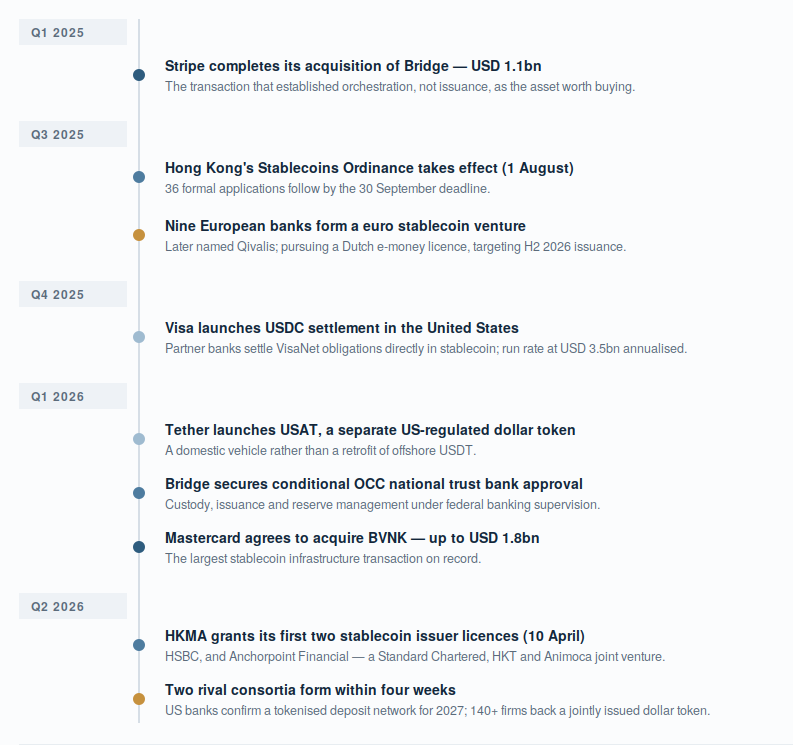
Selected Stablecoin Infrastructure Transactions and Authorizations, February 2025-June 2026
The most significant development of the period arrived on 30 June 2026, when a venture named Open Standard announced Open USD, a jointly backed dollar token with more than 140 participating institutions. The list spans card networks, acquirers, banks and commerce platforms such as Visa, Mastercard, Stripe, Coinbase, BNY, U.S. Bank, Huntington, Citizens, American Express, BlackRock and Shopify.
A consortium coin that arrives pre-integrated with the world’s largest acceptance networks begins the distribution contest with an advantage that took incumbent issuers years to assemble. The breadth of participation and neutral governance are the factors that would distinguish this attempt from prior ones.
Meanwhile the joint-venture route is proving to be the preferred structure wherever regulation is tight. Anchorpoint in Hong Kong pairs a global bank’s balance sheet with a telecom’s distribution and a digital-asset firm’s technical capability. Qivalis in Europe assembles more than a dozen banks behind a single license rather than each pursuing its own. Both structures solve the same problem: the compliance cost of stablecoin issuance is largely fixed, and no single mid-sized institution can justify it alone.
The Incumbent Counter-Move: Tokenized Deposits
The banking system’s response has now taken concrete form. JPMorgan Chase, Citigroup, Bank of America, Wells Fargo and other large US commercial banks are building a shared tokenized deposit network operated by The Clearing House, which they jointly own, targeting launch in the first half of 2027. Components already exist in fragments: JPMorgan’s institutional deposit token on a public layer-two network, Citi Token Services running real-time transfers between New York, London and Hong Kong, and BNY’s institutional tokenized deposit service launched in January 2026. A separate consortium of regional lenders is targeting retail tokenized deposits with a pilot from the third quarter of 2026.
A tokenized deposit is a claim on an insured bank, carrying that bank’s credit profile, existing regulatory treatment and existing accounting treatment. A stablecoin is a claim on a segregated reserve pool held by a non-bank issuer. The first keeps money inside the banking system; the second moves it outside. That is the entire commercial argument, and it is why the FDIC has proposed that tokenized deposits be treated as deposits wherever they functionally mirror the definition, regardless of labelling.
The competitive stakes are large enough to explain the urgency. Bank of America’s chief executive suggested in January 2026 that as much as USD 6 trillion in deposits could eventually migrate to stablecoins if regulators permit yield-bearing structures.
Our working assumption for client planning is that these systems converge rather than compete outright. Stablecoins’ most immediate value may be as components within hybrid models, integrated with bank money and interoperable settlement, rather than as standalone global rails. Enterprises should therefore be building rail-agnostic payment architecture.
Monetary Sovereignty and the Emerging-Market Divide
For businesses operating across developing markets, the most consequential variable is not technology. It is whether the local central bank regards dollar stablecoins as infrastructure or as a threat.
Approximately 99% of stablecoin supply is dollar-denominated. Where local currencies are volatile and hard currency is rationed, that is precisely the appeal and precisely the concern. The cross-border circulation of dollar stablecoins poses a more acute financial-stability and macroeconomic risk to emerging and developing economies than to advanced ones.
India illustrates the restrictive end of the spectrum with unusual clarity. The Reserve Bank of India has maintained a position favouring the exclusion of regulated lenders from crypto-asset exposure, and has argued against both foreign-currency and rupee-pegged stablecoins on grounds of monetary sovereignty, seigniorage erosion and contagion risk during stress. Its stated alternative is sovereign digital infrastructure: the digital rupee, programmable CBDC pilots including subsidy distribution deployments, and cross-border CBDC work with partners including the Monetary Authority of Singapore and the United Arab Emirates. Private rupee-token initiatives exist, but they are being designed to complement rather than compete with the central bank’s rails.
Europe sits at a different point on the same axis. Euro-denominated stablecoins reached roughly EUR 450 million in circulation by January 2026, a ninefold rise in two years. The European Central Bank’s answer runs on two tracks: encouraging MiCA-compliant euro issuance by European banks, and advancing the digital euro, for which 36 providers were selected from 57 applicants for pilot work, with beta testing anticipated from late 2027 and possible first issuance in 2029.
The Strategic Read
Stablecoin payment infrastructure is a settlement component that has cleared regulatory legitimacy in the world’s major financial centers, attracted several billion dollars of acquisition capital, and captured a small but rapidly growing share of genuine cross-border payment volume while remaining a fraction of a per cent of global flows.
That combination is exactly the profile of an infrastructure technology in the early middle of its adoption curve: the institutions that will define it have committed, the standards have not settled, and the returns will accrue to organizations that build optionality rather than conviction.
The firms that will benefit are not those that pick the right token. They are those that redesign treasury and payment architecture so that the choice of rail becomes a configuration decision rather than a strategic one — and that do the corridor-level, control-level and jurisdiction-level work now, while the standards are still being written and there is still time to influence which ones they build against.