-
- Global long-duration energy storage (LDES) installations exceeded 15 GWh in 2025, up 49% year on year, yet LDES still represented only about 6% of all storage installed. China accounts for roughly 93% of cumulative deployment.
- The 8 to 12 hour band is no longer the preserve of novel technologies. Lithium-ion projects of 8 to 18 hours are winning government-backed long-duration contracts in Australia, U.K. and Italy.
- Revenue certainty is being designed in by regulators: U.K. cap and floor, Italy’s MACSE, Japan’s long-term decarbonization auction and the New South Wales LTESA programme are now the reference models.
- Venture funding fell sharply in 2025. Capital is being replaced by corporate offtake (Google with Form Energy and Energy Dome), platform joint ventures (Eos with Cerberus) and insured technology performance, while weaker players consolidate or exit.
The Duration Gap: Why Grids Are Now Buying Hours
For most of the last decade, storage procurement was a power question: how many megawatts of fast-response capacity could be connected and how quickly. As variable renewable shares climb past 50% in markets such as Germany, Australia and Denmark, the question has become one of energy: how many hours can a system carry demand through a still, overcast evening, a windless week or a seasonal shortfall.
Under net zero scenarios, the global average duration of installed storage needs to rise from about 2.5 hours today to around 20 hours. The LDES installations passed 15 GWh in 2025, a 49% increase, after an exceptional 806% jump between 2023 and 2024. Yet LDES made up only 6% of 2025 storage installations, and China represented 93% of cumulative global deployment, supported by provincial mandates and its 2025 to 2027 special action plan for new energy storage.
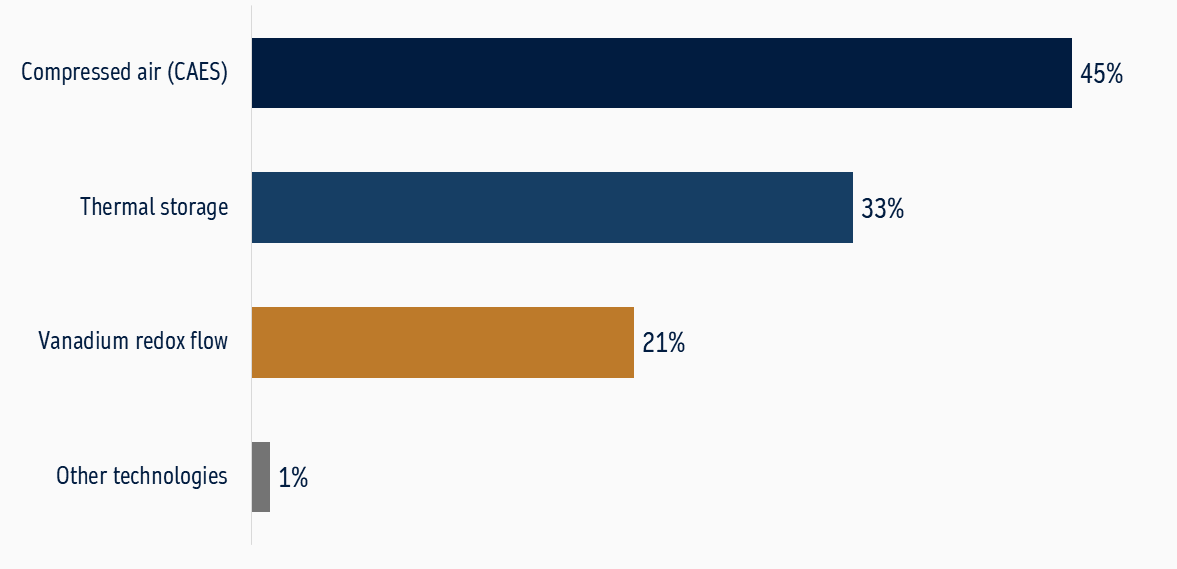
Global LDES installations by technology, 2025 (share of installed energy)
Two features of this mix matter for strategy. First, the leading technologies are those with mature engineering supply chains and established EPC partners, not the most novel chemistries. Second, the average durations actually being built remain short relative to the 20-hour system requirement. The gap between what grids will eventually need and what markets currently pay for is the central commercial problem in LDES.
The Lithium-Ion Encroachment: 8 To 12 Hours is Contested Ground
The most consequential development of the past eighteen months is not a new chemistry. It is the steady extension of lithium-ion iron phosphate (LFP) batteries into durations once assumed to belong to compressed air, flow batteries and thermal systems.
New South Wales provides the clearest evidence. Across its Roadmap long-duration tenders, 13 projects totalling 2,770 MW and 30,362 MWh have been awarded Long-Term Energy Service Agreements (LTESAs), and 11 of them are lithium-ion. Round 6, announced in February 2026, awarded 1.17 GW and 11.98 GWh to six lithium-ion projects with durations from 8.7 to 11.5 hours. Hydrostor’s Silver City compressed air project, one of only two non-battery LTESA winners, no longer holds its agreement and is eligible for future tenders.
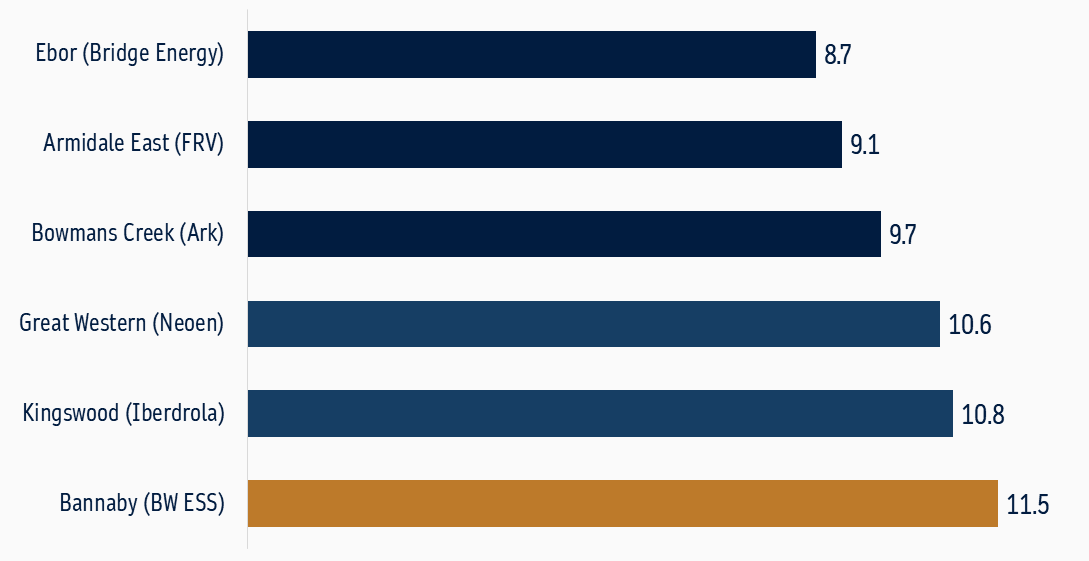
Nominal duration of lithium-ion projects awarded long-duration LTESAs, NSW Round 6 (hours)
The pattern repeats elsewhere. In U.K., battery owner-operator Field secured five projects in Ofgem’s first long-duration cap and floor shortlist, totalling 1.6 GW and 26.8 GWh with an average duration of about 16.75 hours, and an 18-hour lithium-ion project sits among the selected portfolio. In Italy, all 10 GWh procured in the first MACSE auction went to large lithium-ion projects. Japan’s latest long-term decarbonization auction raised the minimum battery duration to six hours, which more than halved bid volumes but still cleared 551 MW of lithium-ion.
Country By Country: How Policy Is Pricing Duration
United Kingdom: The Cap and Floor Becomes the Global Reference Model
Ofgem opened the first LDES cap and floor window in April 2025, offering a revenue floor to manage high capital costs and long build times, and a revenue cap that returns upside to consumers. In September 2025 it shortlisted 77 projects totalling 27 GW. On 26 June 2026 it published a minded-to decision selecting 16 projects totalling 7,645 MW, with durations of 8 to 22 hours and a mix that includes lithium-ion, three pumped hydro schemes (SSE’s Coire Glas, Gilkes Energy’s Earba and Statera’s Loch Kemp), compressed air and flow batteries. The selected capacity sits at the top of Ofgem’s guided 2.7 to 7.7 GW range, deliberately sized to absorb attrition. Final awards are expected in autumn 2026, with a second window subject to consultation in 2026 and a design decision by 2027.
China: Scale First, Diversification Second
China’s National Energy Administration reported 136 GW of new-type (non-pumped hydro) storage installed by the end of 2025, up 84% year on year; the China Energy Storage Alliance (CNESA) counts 144.7 GW, with pumped hydro making up a further 31% of total power-sector storage. LFP still accounts for more than 98% of new-type capacity. The long-duration story sits in demonstration and early commercial plants: by September 2025, flow battery installations had reached 1.15 GW and compressed air 830 MW, multiple 300 MW-class compressed air projects had been filed, and the Yumen 300 MW compressed air and Golmud 60 MW liquid air projects entered commissioning. Chinese researchers expect average installed duration to rise from 2.58 hours in 2025 to about 3.47 hours by 2030, a modest shift that still implies very large absolute volumes of longer-duration capacity.
United States: Hyperscalers and Federal Credit Fill The Gap Left by Markets
U.S. has no national LDES procurement mechanism, and two very different instruments are substituting for one. The first is federal credit: Hydrostor’s 500 MW / 4 GWh Willow Rock advanced compressed air project in California holds a conditional DOE loan guarantee of up to US$1.76 billion, more than three times any previous DOE guarantee to an LDES technology, and has received final permitting approval from the California Energy Commission. The second, and more strategically significant, is corporate offtake. In February 2026 Google and Xcel Energy agreed a 300 MW / 30 GWh, 100-hour Form Energy iron-air deployment in Minnesota, the largest battery announced globally by energy capacity, with the associated service agreement awaiting state regulatory approval in early 2027. Weeks later, Form agreed 12 GWh of capacity for AI infrastructure developer Crusoe with deliveries from 2027, taking its contracted pipeline above 75 GWh.
India: The Largest Structural Requirement Outside China
India’s Central Electricity Authority estimates that the country’s storage requirement will rise to 62 GW by 2029-30, 161 GW by 2034-35 and 476 GW by 2046-47. The CEA has published a roadmap to 100 GW of pumped storage by 2035-36, and the National Electricity Plan envisages around 26.7 GW of pumped storage alongside 47.2 GW of batteries by 2032. The CEA Chairman has noted that almost the entire pumped storage pipeline now comes from private developers, and that single-site projects above 3,600 MW and 5,000 MW are in planning.
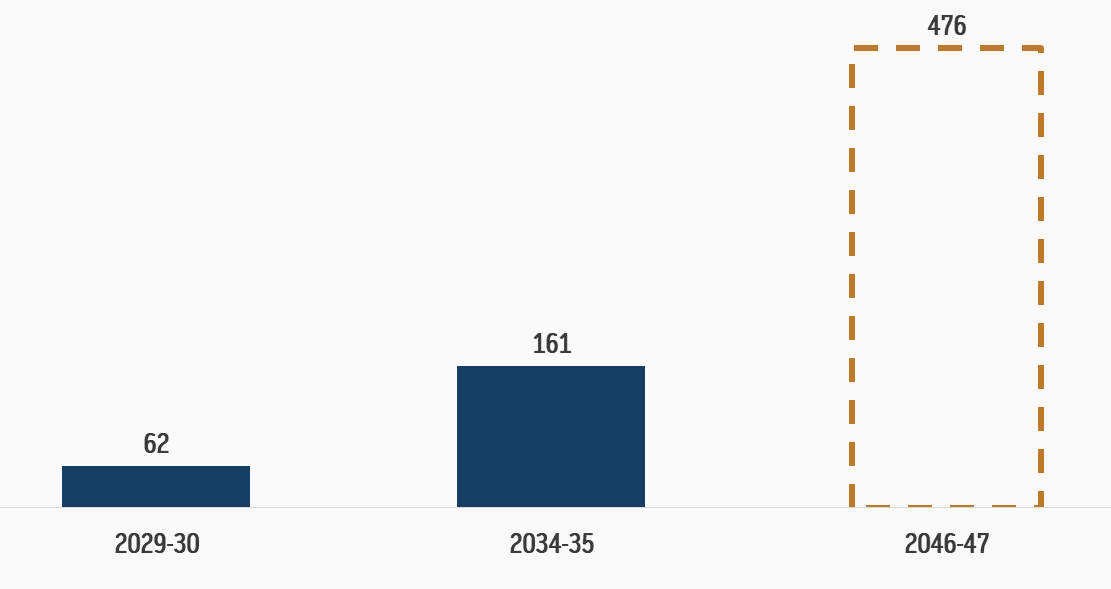
India’s projected energy storage capacity requirement (GW)
For international technology providers, India’s opportunity is real but channel-dependent: state-allocated pumped storage, central tenders for round-the-clock and firm renewable supply, and domestic manufacturing preferences all shape entry strategy. Early local innovation is also appearing, including a seed-funded iron-air developer targeting 100-hour discharge.
Australia: long-term service agreements and pumped hydro at scale
Combined Capacity Investment Scheme and LTESA tenders have contracted 13.8 GW / 67.6 GWh of battery capacity across the National Electricity Market. The 2.2 GW Snowy 2.0 pumped hydro scheme remains under construction. Hydrostor’s 200 MW / 1.6 GWh Silver City project at Broken Hill illustrates both the backing and the friction facing first-of-a-kind plants: it has attracted a US$200 million commitment led by Goldman Sachs Alternatives and US$55 million from Export Development Canada but also faced a successful planning appeal in March 2026 that added consent conditions.
Continental Europe and Ireland: capacity contracts set the price signal
Italy’s MACSE mechanism aims to procure about 50 GWh of storage by 2030 through 15-year contracts. The first auction cleared 10 GWh at a weighted average premium of roughly EUR 12,959 per MWh-year against a EUR 37,000 ceiling, a result widely described as highly competitive and one that favours developers with scale purchasing power. The second auction, for 16 GWh with 2029 delivery, is scheduled for 24 November 2026. In Ireland, Google and Energy Dome are developing a 23 MW / 200 MWh CO2 Battery near Rhode, County Offaly, backed by a 10-year capacity contract with operation expected in 2028. In the DACH region, Eos has signed an exclusive distribution agreement with CAPAC Energy for an initial 750 MWh, scalable to 2 GWh through 2031.
Japan: a dedicated lane for non-lithium and new pumped hydro
Japan’s third long-term decarbonization auction, published by OCCTO in May 2026, split storage into two categories: one for lithium-ion and pumped hydro repowering, and another for new pumped hydro, non-lithium batteries and LDES. Non-lithium technologies secured 699 MW, ahead of lithium-ion at 551 MW, while two pumped hydro projects (TEPCO Renewable Power’s Shiobara repowering and Hokkaido Electric’s Kyogoku expansion) won about 453 MW. Japan is the clearest example of a regulator ring-fencing procurement to support technology diversity.
Capital, M&A and Joint Ventures: The New Deal Architecture
The financing environment has tightened markedly. Wood Mackenzie estimates that overall LDES funding fell 30% globally in 2025 once the Hydrostor DOE commitment is excluded, and that venture capital investment fell 72%, citing high interest rates, long payback periods and competition for capital from AI data center build-outs. In response, four deal archetypes are reshaping the sector.
Corporate offtake as quasi-equity
Hyperscalers are now underwriting first commercial volumes. Beyond the Form Energy agreement in Minnesota, which industry sources have characterized as an approximately US$1 billion commitment, Google signed its first LDES partnership with Energy Dome in 2025 to support multiple deployments worldwide and has since moved to a second project in Ireland. For technology providers, this offtake substitutes for the reference-plant track record that lenders require.
Platform joint ventures and insured performance
In May 2026 Eos Energy and Cerberus Capital Management announced Frontier Power USA, an independent developer and future IPP built around Eos’s zinc-based Z3 technology. The structure combines a 2 GWh firm capacity reservation, a US$100 million anchor equity commitment from Cerberus and a 15-year, non-cancellable technology performance insurance framework of about US$1.5 billion arranged with specialty insurer Ariel Green. The vehicle had raised about US$263 million by mid-2026 and represented 49% of Eos’s backlog volume. This is the template to watch: technology risk wrapped by insurance, project risk held by an infrastructure-style sponsor.
Distressed consolidation and IP acquisition
The shakeout is under way. ESS Tech acquired the IP and assets of German iron-salt battery developer VoltStorage, which had ceased operations in mid-2025; in October 2026 ESS’s own shares were suspended from the NYSE and moved to over-the-counter trading. Liquid metal battery developer Ambri was acquired by its lenders through a US$9.5 million credit bid in a Section 363 bankruptcy sale. For acquirers, this environment offers access to IP, test data and engineering teams at a fraction of the capital originally invested.
Developer portfolio M&A around contracted assets
Where long-term contracts exist, conventional developer M&A follows quickly. In Italy, OX2 acquired 200 MW of four-hour battery projects from Hanwha ahead of the second MACSE round. Similar secondary activity can be expected in the UK once cap and floor awards are finalized, as development-stage sponsors recycle capital to construction-capable owners.
What To Watch Through 2027
The next twelve to eighteen months contain an unusually dense sequence of decision points that will determine pricing benchmarks and competitive positions:
-
- Autumn 2026: Ofgem’s final cap and floor awards and license conditions, which will set the first regulated LDES revenue benchmarks in Europe.
- 24 November 2026: Italy’s 16 GWh MACSE auction, a test of whether the first round’s aggressive pricing holds.
- Early 2027: Minnesota regulatory decision on the Google and Xcel service agreement that includes the 30 GWh Form Energy system.
- 2027: UK decision on the design of cap and floor window two, and first Form Energy deliveries to Crusoe.
- 2028 to 2030: commercial operation of Energy Dome in Ireland (2028), Italy’s first MACSE delivery year (2028), and the targeted commissioning of Willow Rock (2030).
Strategic Implications by Stakeholder
Technology providers should reposition explicitly around duration bands where lithium-ion is uneconomic, secure a performance insurance or balance-sheet wrap early, and treat corporate buyers as a primary channel rather than a supplement to utility sales.
Developers and IPPs should build portfolios around regulated windows, with sequencing plans that match the UK, Italy, Japan and Australia calendars, and model attrition risk as Ofgem has done when sizing bids.
Utilities and system operators can learn from the divergence between technology-neutral regimes, which have favoured lithium-ion, and ring-fenced lanes such as Japan’s, which preserve diversity. Procurement design is effectively industrial policy.
Investors have an opening in distressed IP and in platform vehicles that pair capital with contracted pipelines, but diligence must focus on manufacturing readiness, degradation data and the enforceability of warranties.
Large energy buyers, particularly data center operators, can secure capacity reservations and favourable pricing by committing early, as Crusoe has done, but should structure delivery milestones and step-in rights carefully.