Something unprecedented is happening on the world’s factory floors. Robot installations have doubled globally in ten years. Nearly nine in ten organizations now deploy artificial intelligence in at least one business function. Foundation models, the same architectural breakthroughs that gave us generative AI, are being trained to control humanoid robots. Digital twins are evolving from static 3D models into living, and physics-accurate decision engines capable of predicting failures weeks before they occur.
Yet beneath these headline numbers lies a paradox that should concern every industrial executive. Fewer than one in fifteen companies, roughly 6%, report that AI is delivering meaningful impact on their bottom line. Two-thirds remain trapped in what the industry now calls “pilot purgatory,” running isolated experiments that never scale. A select group of 200 advanced factories are recognized globally for their digital excellence which achieved 50% productivity gains and 80% defect reductions.
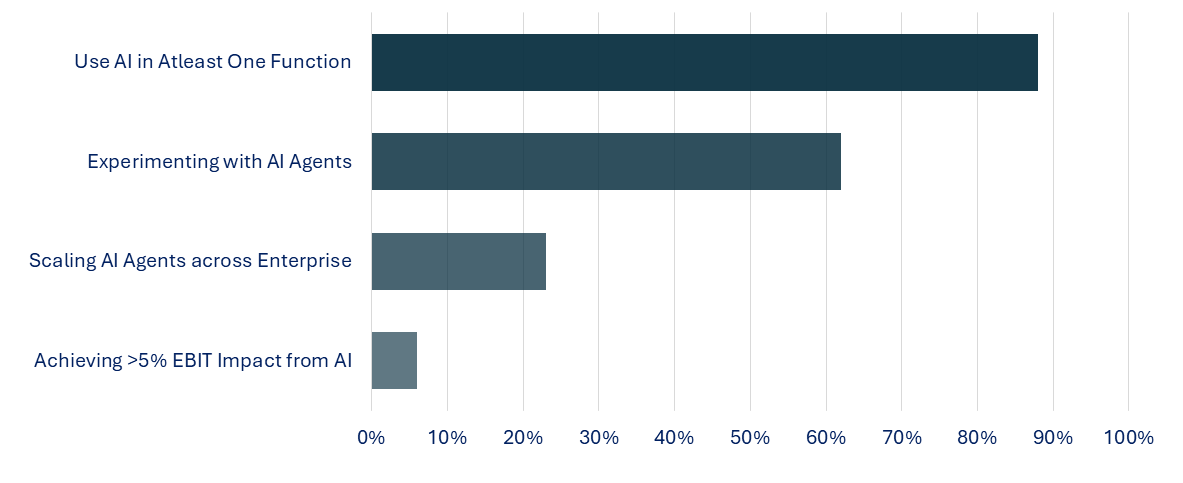
Industrial AI Paradox: Near-Universal Adoption, Rare Value Capture (% Of Organizations, 2025)
The Fourth Industrial Revolution is here but its benefits are being captured by a remarkably small group of organizations that have cracked the code on scaling, not just on technology adoption.
The Great Convergence: Four Technology Forces Colliding Simultaneously
What makes 2025–2026 different from the previous decade of Industry 4.0 promises isn’t any single technology. It’s the simultaneous maturation of four forces that, together, are collapsing the boundary between the digital and physical worlds.
-
- Foundation Models Enter the Physical World
The same transformer architectures that power large language models are now being adapted to give robots generalized intelligence, enabling machines to learn tasks through observation rather than explicit programming.
The breakthrough arrived in March 2025 with the release of the world’s first open foundation model for humanoid robots, a 2-billion-parameter vision-language-action model built on a dual-system architecture inspired by human cognition. One system handles deliberate reasoning i.e. interpreting visual scenes, understanding language instructions, and planning actions. The other handles reflexive motor control, translating plans into precise physical movements in real time.
The model is already deployed across leading robotics companies including Boston Dynamics, Agility Robotics, and within Amazon’s fulfillment operations. A collaboration between three of the world’s leading AI research organizations has produced an open-source physics engine purpose-built for robot learning, accelerating training simulations by over seventy times.
-
- Digital Twins Become Predictive Decision Engines
At CES 2026, the integration of industrial digital twin technology with GPU-accelerated simulation libraries produced a new class of software that allows companies to rewind and fast-forward time in a virtual 3D environment i.e. simulating the effects of weather changes, equipment modifications, or supply chain disruptions on production outcomes. One major food and beverage company deploying this technology across its U.S. manufacturing and warehouse facilities reported that 90% of potential issues are now identified before any physical modifications occur, with a 20% throughput increase on the initial deployment and a 10% to 50% reduction in capital expenditure by uncovering hidden capacity.
This represents a shift from digital twins as visualization tools to digital twins as living decision-making systems i.e. continuously updated with real-world data, capable of autonomous optimization, and increasingly integrated with AI agents that can act on their insights without human intervention.
-
- Agentic AI Moves from Experiment to Operating System
Over 60% of organizations are now experimenting with AI agents, though fewer than 10% have scaled them at functional level. One of the world’s largest electronics contract manufacturers scaled an AI agent ecosystem that automates 80% of decision workflows across its global operations, unlocking an estimated USD 800 million in value. In supply chain operations, AI agents have demonstrated the ability to detect disruptions up to two weeks earlier than traditional monitoring, reduce warehousing costs by USD 15 million, and halve staffing requirements for specific logistics functions.
-
- Physical Robotics Reaches an Inflection Point
The installed base of industrial robots worldwide reached 4.66 million units in 2024, with 542,000 new installations, the fourth consecutive year above the half-million mark. The cobot segment grew 12%, and now represents nearly 12% of all installations, up from under 3% just seven years ago.
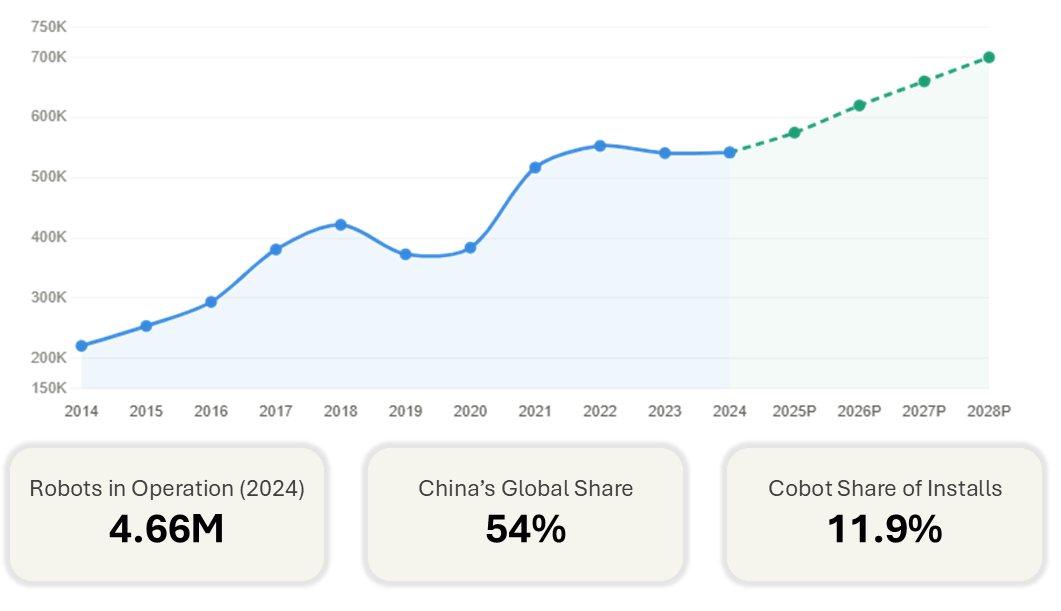
Annual new installations industrial robots (thousands of units) (2014–2028)
But the most consequential shift is the emergence of humanoid and general-purpose robots. Estimates suggest the humanoid robot market could reach USD 38 billion by 2035, with shipments of 1.4 million units. Manufacturing costs have dropped approximately 40% year-over-year, and one Chinese manufacturer stunned the market by launching a functional bipedal humanoid at just $5,900, a price point previously considered impossible for years to come.
Study on nine major Chinese robotics supply chain companies revealed a “capacity-first” strategy where suppliers are building production capacity for 100,000 to one million robot-equivalent units, anticipating a mass-production inflection point in the second half of 2026. Major automakers are testing humanoids for precision assembly tasks that traditional industrial robots cannot perform i.e. fine manipulation, complex gripping, and two-handed coordination. The material costs of a humanoid robot are projected to fall from roughly $35,000 today to between $13,000 and $17,000 within a decade.
Where Value Is Being Created: Applications Across the Industrial Value Chain
The gap between AI hype and AI value narrows dramatically when we look at specific application domains where proven returns are being generated today.
1. Predictive Maintenance and Quality Assurance
This remains the highest-ROI entry point for industrial AI. AI-driven quality control has demonstrated the ability to reduce manufacturing costs by up to twenty percent. Predictive maintenance powered by machine learning is cutting maintenance budgets by 25% to 40% while reducing unplanned downtime by as much as 70%. AI-driven supply chain simulations are achieving 30% improvements in forecast accuracy and 50-80% reductions in delays and downtime.
In advanced manufacturing facilities which are recognized for digital excellence, AI-enabled visual inspection systems are saving between €30,000 and €100,000 per inspection station while delivering autonomous quality control that outperforms manual processes. The latest cohort of these globally recognized smart factories has achieved an average 40% decrease in product defects, 44% percent reduction in cycle time, and 28% percent decrease in energy consumption.
2. Supply Chain Intelligence
Supply chains have proven to be among the most fertile grounds for AI deployment. AI agents capable of orchestrating supply chain operations are detecting disruptions weeks in advance, enabling proactive rather than reactive response. Inventory systems powered by AI-driven storage and retrieval achieve 75% faster fulfillment speeds and across the most advanced supply chains, digital solutions are delivering over 20% reductions in energy consumption, 27% reductions in inventory holding costs, and 55% reductions in scrap and waste.
3. Autonomous Logistics and Warehousing
The world’s largest robotics fleet operator now runs more than one million robots across over three hundred fulfillment centers globally, a population that rivals its human workforce of approximately 1.5 million. These robots range from autonomous guided carts to advanced mobile units capable of navigating among human workers, and robotic arms designed for individual item picking, one of the most complex tasks in logistics. The fleet is now orchestrated by a generative AI foundation model that coordinates thousands of robots simultaneously, optimizing movement patterns and reducing congestion in real time.
Robot-as-a-Service models are democratizing access, converting large capital expenditures into manageable operating expenses and allowing even mid-sized manufacturers to deploy advanced automation without massive upfront investment.
4. Sustainability as a Performance Outcome
Perhaps the most underappreciated application of industrial AI is its contribution to environmental sustainability, not as a corporate responsibility initiative, but as a measurable performance outcome. The world’s most advanced manufacturing sites are achieving 30-50% reductions in Scope 1 and Scope 2 emissions, 25% reductions in energy and water consumption, and 30% reductions in material waste through AI-optimized processes. One industrial site in Germany is on track to achieve net-zero operations by 2026, four years ahead of its corporate target, having achieved energy savings of 12% in absolute terms and 64% per unit of volume, even as overall throughput increased by 145%.
What Separates the Best from the Rest
Since 2018, a global initiative jointly managed by the World Economic Forum has been recognizing the world’s most advanced manufacturing sites, collectively known as the Lighthouse Network. They are operating factories that have achieved step-change improvements through technology-enabled transformation and their trajectory reveals the clearest pattern of what separates winners from laggards.
The network has grown to 201 certified sites across thirty countries and thirty-five sectors. In 2019, only ten percent of these leading factories had significant AI implementations. By 2023, one hundred percent of new inductees were deploying advanced AI at scale. In the most recent cohort, AI and generative AI enable up to fifty percent of all implemented use cases.
Three organizational insights distinguish these leaders:
-
-
- They solve problems, not deploy technology. Lighthouse factories begin with the business challenge (i.e. throughput, quality, energy, lead time) and work backward to the technology. They don’t adopt AI because it’s available. They adopt it because it solves a specific and measured constraint.
- They scale through standardization. Successful sites package proven use cases into replicable modules, an approach described as “assetization”, that can be deployed rapidly across facilities and geographies. This converts every successful pilot into an accelerant for the next deployment.
- They invest in people as aggressively as in machines. One Chinese factory deployed 35 workforce empowerment solutions, including personalized career pathways, innovation incentive platforms, and AI-driven workforce planning. As a result, attrition reduced by 40% and participation rates reaching 61%.
-
The Geopolitics of Industrial Intelligence
The global race for industrial AI supremacy is reshaping manufacturing geography.
China has established an overwhelming lead in sheer scale. With 295,000 robot installations in 2024, 54% of the global total, and an operational stock exceeding two million units, China’s manufacturing base is automating at a pace that no other economy can match. Over six hundred robotics investment deals were recorded in the first nine months of 2025 alone. Chinese suppliers are proactively building humanoid production capacity ahead of confirmed orders, betting on a mass-production inflection in late 2026.
United States is countering with policy and platforms. The CHIPS and Science Act has accelerated domestic AI semiconductor manufacturing, reducing lead times for AI-enabled hardware by approximately forty percent. The reshoring trend is driving new demand for advanced automation where industrial robot integrators are opening new operations hubs to support domestic manufacturing expansion. America’s strategic advantage lies not in installation volume but in the software and AI model layer, where its leading technology companies maintain a significant edge.
Europe commands the world’s highest robot density with 267 robots per 10,000 manufacturing employees in Western Europe and is pursuing a distinctive regulatory-led approach. The EU AI Act classifies many factory applications as high-risk, creating compliance costs but simultaneously building a trust framework that may become a global standard. European industrial champions are integrating sustainability requirements directly into their automation strategies, treating environmental performance as inseparable from operational performance.
India is the fastest-growing frontier. Record installations of 9,100 units in 2024, up 7%, placed India sixth globally, overtaking established markets. With automotive driving 45% of demand and a rapidly expanding electronics manufacturing base, India’s trajectory suggests it will be a major deployment market within the decade.
The Risks No One Wants to Discuss
1. Cybersecurity Exposure
As factories become software-defined environments, they inherit the vulnerabilities of connected systems. Manufacturing ranks among the top three industries targeted by cyberattacks. Experts cite rising hacking attempts targeting robot controllers and cloud platforms, the very systems that industrial AI depends upon. The more intelligent the factory is, the larger the attack surface.
2. The Explainability Deficit
Deep learning models that drive many industrial AI applications are, by design, opaque. They produce results that are difficult or impossible to explain, even to their own developers. In regulated environments (i.e. pharmaceuticals, aerospace, food production) this opacity creates legal and ethical ambiguity around liability that current governance frameworks are not equipped to resolve.
3. Concentration and Fragility
Eighty percent of all industrial robot installations occur in just five countries. A single market, China, accounts for more than half. This concentration creates systemic fragility. Supply chain disruptions, trade restrictions, or geopolitical tensions could fracture the robotics ecosystem in ways that would ripple through global manufacturing.
4. The Human Transition
Robotics and autonomous systems will be significant sources of job displacement in the coming decade. But the same analyses that predict displacement also predict the creation of new skilled roles such as robot technicians, predictive maintenance specialists, AI system operators, and fleet coordinators. The critical variable is speed: whether the creation of new roles can keep pace with the displacement of old ones. Organizations that invest in workforce transformation will navigate this transition. Those that don’t will face both operational and social consequences.
The Strategic Playbook: Five Moves for the Next Eighteen Months
-
- Treat AI as an operating system, not a feature
At CES 2026, the CEO of one of Europe’s largest industrial conglomerates framed the moment with clarity: “Just as electricity once revolutionized the world, industry is now undergoing a profound transformation.” The leaders are not adding AI to existing operations. They are building AI-native operations from the ground up where integrated intelligence spans across design, production, supply chain, and delivery.
-
- Escape pilot purgatory through ruthless workflow redesign
The single strongest predictor of AI value creation is not the quality of the model or the size of the dataset. It’s whether the organization has fundamentally redesigned its workflows around AI capabilities. The companies seeing transformative returns don’t bolt AI onto existing processes; they rebuild processes around what AI makes possible.
-
- Build the digital twin foundation now
Digital twins are becoming the operating system layer for intelligent factories. Companies without a digital twin strategy by 2027 will lack the infrastructure required for next-generation autonomy from predictive simulation to AI agent deployment. The platform choices being made today will determine competitive positioning for the next decade.
-
- Pilot physical AI with a clear scaling roadmap
The mass-production inflection for humanoid robots is anticipated in late 2026. Companies should begin piloting cobots and autonomous mobile robots now, not as isolated experiments but with explicit thirty-to-sixty-day KPI targets and a defined path from pilot to production line to factory to enterprise. Robot-as-a-Service models lower the entry barrier to manageable operating expenditure.
-
- Invest in workforce transformation with the same rigor as technology investment
Every high-performing factory in the global Lighthouse Network has invested deeply in workforce upskilling and organizational change alongside its technology deployments. Technology-enabled transformation fails without people-enabled transformation. Companies should build central teams for smart manufacturing, invest in reskilling programs, and create career pathways that align workforce development with automation roadmaps.
Conclusion
The Fourth Industrial Revolution spent a decade as aspiration. In 2025–2026, it became operational for the organizations willing to invest not just in technology, but in the organizational rewiring required to capture its value.
Robot installations will exceed 700,000 units annually by 2028. Humanoid shipments could reach 250,000 units by 2030. Generative AI could add nearly half a trillion dollars annually to manufacturing and supply chains. 201 factories leading the global Lighthouse Network are demonstrating, in production, the gains that the rest of the industry is still debating in boardrooms.
The gap between leaders and laggards is widening, and it is becoming structural. The companies that build AI-native, digitally twinned, robotically augmented operations in the next eighteen months will set the competitive baseline for the next decade.