Europe: A 2030 Obligation Running at A 2050 Delivery Rate
On 23 February 2026, the European ERTMS Coordinator published the Third Work Plan on the deployment of the European Rail Traffic Management System. By the end of 2024, the European Train Control System had been deployed on approximately 12,400 route kilometers, around 10% of the TEN-T network, and fitted to roughly 8,730 vehicles, some 19% of the EU rail fleet.
Under the TEN-T Regulation, ERTMS must be in place on the Core Network by 2030, extended to the wider network by 2040, and completed by 2050. The Coordinator’s assessment is that deployment remains materially behind schedule and structurally uneven between Member States.
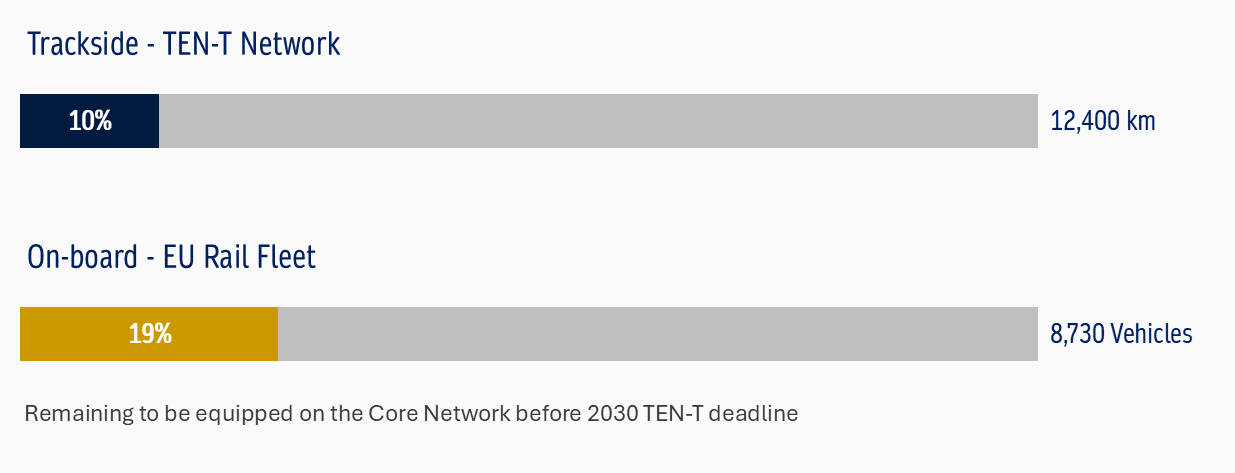
ERTMS Deployment Against A 2030 Core-Network Deadline
Deployment is concentrated in a small group of committed networks such as Denmark, Belgium, Switzerland, parts of Italy and Spain while several large Member States remain in pilot or early corridor phases. For a supplier, that concentration is a pipeline map. For an infrastructure manager, it is a warning that cross-border interoperability benefits do not accrue until neighbors move in step, which weakens any single-network business case built on capacity gains alone.
The On-Board Cost Curve
Between 2018 and 2022, the cost of retrofitting a vehicle with ERTMS rose from approximately €450,000 to approximately €900,000. Upgrade costs over the same period rose from around €200,000 to around €400,000. Both doubled within four years, in a period when the sector was expecting standardization and volume to push unit costs down.
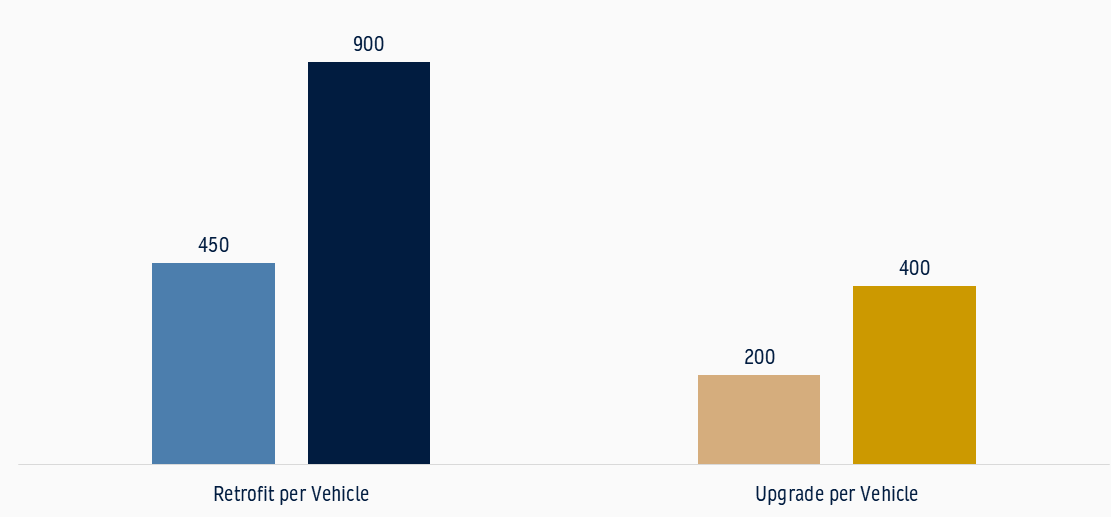
ERTMS On-Board Costs Doubled in Four Years
The drivers identified are instructive because none of them is a component cost. They are engineering scarcity, fragmented and repeated authorization processes, national technical rules that force bespoke variants of a nominally common standard, and small, non-repeating order batches that deny suppliers any learning curve. In other words, the cost escalation is an artefact of how the market is organized, not of what the equipment contains.
A rolling stock owner facing a doubled retrofit bill on a fleet with fifteen years of residual life has a genuine capital allocation question, not a compliance formality. Where the equipped route network remains at 10 per cent, the operational return on that investment is deferred well beyond the payback horizon most leasing companies and freight operators underwrite. Any credible fleet strategy now has to model the trackside rollout of the specific corridors that fleet actually serves.
Procurement Strategies
The most significant structural response has come from Germany. In early 2025, DB InfraGO signed a long-term volume framework worth €6.3 billion with Siemens Mobility (in consortium with Leonhard Weiss), Alstom, Hitachi Rail GTS Deutschland and MerMec Deutschland, covering digital interlockings, ETCS and integrated control and operating systems. The design of the instrument is more interesting than its size: Deutsche Bahn committed to binding call-off quantities, around 15,500 control units including signals and point machines by the end of 2028, in exchange for guaranteed industrial capacity.
By converting a pipeline of individually tendered projects into a committed volume, DB is attempting to give suppliers the certainty required to invest in platform standardization and dedicated delivery teams, and to compress a planning-to-commissioning cycle that had extended to as long as eight years. Call-offs have followed in sequence: Siemens Mobility for the Cologne–Mülheim package in 2025 and a ScanMed corridor package in January 2026; Hitachi Rail for the Riesbahn in February 2026; and Alstom’s first firm order in May 2026, covering 43 km of the Rhine-Alpine Corridor between Ratingen West and Immigrath.
The same logic is visible elsewhere. Queensland’s Department of Transport and Main Roads awarded Alstom an initial A$114 million tranche of an A$354 million frame contract in mid-2026 for ETCS Level 2 on the Sunshine Coast line, structured as a programme rather than a project and explicitly tied to network sectorization ahead of the 2032 Brisbane Games. In Egypt, an Alstom-led consortium with Rowad Modern Engineering and Concrete Plus signed contracts worth €690 million in June 2026 to deploy ETCS Level 1 with power and telecommunications upgrades on the 6 October across Alexandria and Belbes,10th of Ramadan corridors.
For suppliers, framework structures shift the competitive battleground from bid pricing to qualification and capacity. For clients, they transfer a meaningful volume commitment onto the balance sheet before the technical case is fully proven on any given corridor. Both sides need a different risk model than the one that governed project-by-project tendering.
Britain’s East Coast Pathfinder
The East Coast Digital Programme is the most instructive live case study in the market, precisely because it has been transparent about its difficulties. The Welwyn to Hitchin overlay, Britain’s first step towards a signal-free intercity main line, was commissioned as infrastructure in early 2024, and Network Rail has reported successive proving milestones since: multiple trains under simultaneous ETCS control in late 2025, and the first live ETCS Level 2 operation of an LNER Azuma in July 2026, bringing the number of distinct on-board systems proven on the section to four.
Commissioning of the Welwyn–Hitchin section moved by roughly six months, and industry reporting has flagged both cost and delivery pressure. The reasons are the retrofit of multiple fleets from multiple manufacturers to a common software baseline, the sequencing of driver training across several operators, the rebuilding of system approval processes, and the requirement to run conventional and digital signalling in parallel throughout the transition.
Trackside installation is the tractable part of a digital signalling programme. The critical path runs through fleet fitment, software baseline alignment, safety assurance and workforce transition all of which sit with parties that are not the infrastructure manager and often not under the same contract. Programmes scoped as infrastructure works consistently underestimate this. Programmes scoped as multi-party operational change consistently do better.
India: A Different Industrial Model
India offers the clearest current counter-example to the European pace problem. Kavach, the indigenous automatic train protection system developed with the Research Designs and Standards Organization, was adopted as the national ATP standard in 2020; Version 4.0 was approved in July 2024 following operational experience with Version 3.2 on the South Central Railway.
The commissioning trajectory has been steep. The Ministry of Railways reported 738 route kilometers commissioned under Version 4.0 by December 2025; a single-day record of 472.3 route kilometers in January 2026 taking the total past 1,300; 1,638 route kilometers by late March 2026 with work in progress across 24,427 route kilometers; and, by July 2026, 2,490 route kilometers commissioned across the Delhi–Mumbai and Delhi–Howrah corridors, supported by 11,253 km of optical fibre, 1,668 telecom towers and 958 station data centers.
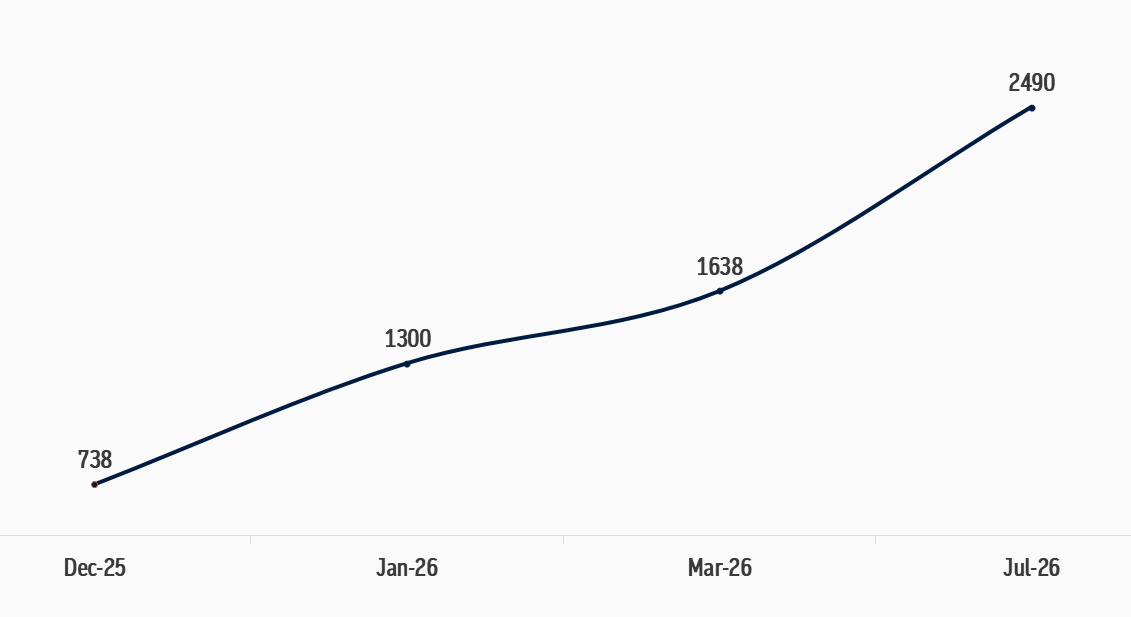
Kavach 4.0 Commissioning on Indian Railways (in kilometers)
Three features of the Indian model explain the pace, and each is transferable in principle. First, a single specification authority with genuine change control, which suppresses the national-variant problem that inflates European costs. Second, vertically bundled scope i.e. trackside, optical fibre backbone, telecom towers, station data centers and locomotive fitment procured as one programme rather than as separately optimized packages. Third, published unit economics: trackside at roughly ₹50 lakh per kilometer and locomotive fitment at approximately ₹80 lakh per unit, against ₹3,874.90 crore spent to June 2026. Transparent unit costs make scaling a budgeting exercise rather than a negotiation.
Kavach is a national system, not an interoperable one, and it has not yet been tested at the scale of cross-border traffic that ERTMS exists to serve. India is also solving a different problem such as collision avoidance on a dense mixed-traffic network and has accepted a longer runway on automation. Suppliers evaluating the market should also note the parallel industrial build-out around it, including the entry of international signalling groups into Indian train detection and interlocking supply.
From Protection to Automation: Where the Value is Moving
On the main line, Deutsche Bahn’s Digital Node Stuttgart is the reference project: an entire railway node converted to ETCS Level 2 with Automatic Train Operation at Grade of Automation 2, with roughly 500 regional and S-Bahn vehicles being equipped and around 500 km of track fitted with the necessary trackside systems. Following the Digital S-Bahn Hamburg pilot, this is the first attempt to run GoA2 over ETCS across a complete mixed-traffic node in commercial service. The capacity mechanism is straightforward, more consistent driving profiles permit shorter headways and better recovery from perturbation, and it is the mechanism that converts a signalling investment into revenue-earning paths.
In urban rail, the trajectory is already established. UITP’s global metro statistics record 2,279 km of fully automated GoA4 lines at the end of 2023, representing 11 per cent of global metro route length, up from 6% a decade earlier. Automated route kilometers grew 75% between 2020 and 2023, with Asia-Pacific accounting for 67% of the global automated total and Shanghai operating the largest single automated network at 174 km. Sixty urban agglomerations now have at least one GoA4 line.
India has also produced a genuine first in this space. The Meerut Metro, opened in early 2026 as part of the Delhi–Ghaziabad–Meerut Namo Bharat corridor delivered by NCRTC with Alstom, is the first metro system worldwide to enter commercial service using ETCS Hybrid Level 3 over an LTE bearer, a mainline standard applied to urban operations specifically to preserve interoperability between regional and metro services. NCRTC has indicated that subsequent RRTS lines will move to 5G.
North America: PTC as a Platform, and Autonomy at The Edges
United States completed a different journey. The Federal Railroad Administration confirmed in December 2020 that Positive Train Control was operational across all 57,536 required freight and passenger route miles, with each host railroad’s system certified and interoperability achieved between host and tenant railroads. Whatever the debate over its cost and duration, PTC left North America with something Europe does not yet have: a continent-scale, interoperable, safety-certified train control platform already in service.
That platform is now enabling adjacent business models. Parallel Systems secured FRA approval in 2025 to pilot autonomous battery-electric container cars on Genesee & Wyoming short lines in Georgia, on a 160-mile route linking the Port of Savannah to inland distribution, a programme granted 22 regulatory waivers subject to 23 operating conditions, with PTC compatibility validated in work with Union Pacific. The vehicles are designed to platoon in groups without couplings and to compete with short-haul trucking rather than to replace conventional trains.
The strategic read is that PTC’s value is turning out to be less about the safety case that mandated it and more about the digital substrate it created.
Two Constraints Shaping The Next Investment Cycle
1. Radio: FRMCS Transition
GSM-R, the 2G bearer underpinning ERTMS, is approaching obsolescence, with industry support guaranteed on a general basis only to around 2030. Its successor, the 5G-based Future Railway Mobile Communication System, is being standardized by UIC with the first implementable edition targeted for inclusion in a revised CCS TSI, and validation running through the MORANE-2 programme. National timelines diverge widely i.e. SNCF Réseau targeting completion around 2030, Switzerland planning GSM-R deactivation by 2035, Deutsche Bahn transitioning over a decade which means most networks face a prolonged period of dual-bearer operation.
For anyone specifying on-board equipment today, this is the live procurement risk. Fitting a vehicle for ETCS without a defined and contracted FRMCS migration path builds a second retrofit into the asset’s life. That is precisely the kind of avoidable rework that produced the cost curve in Figure 2.
2. Cyber: From Technical Specification to Enforceable Standard
Rail cybersecurity is moving from guidance to obligation. CENELEC’s CLC/TS 50701, published in 2021, is being carried into an international standard, IEC 63452, developed under IEC TC9 with input from ERA, ENISA and UITP, and expected to supersede TS 50701 in Europe. It sits alongside the NIS2 Directive and the Cyber Resilience Act, which together extend regulatory exposure to operators and suppliers of digital signalling assets.
The practical consequence is that cyber assurance is becoming a lifecycle obligation on safety-critical control systems such as interlockings, radio block centers, and traffic management rather than a perimeter IT concern. Contracts signed in 2026 for assets commissioning in 2030 will be judged against a standard that is only now being finalized. Contractual allocation of that compliance risk is a live negotiation issue on every major framework currently in the market.
Consolidation: The Supplier Landscape is Being Rebuilt Around Signalling
Capital is moving decisively towards signalling and digital intelligence, and away from rolling stock as the primary source of returns.
|
Transaction |
Value |
Strategic logic |
| Hitachi Rail acquires Thales Ground Transportation Systems (completed 31 May 2024) | €1,660m enterprise value | Created a combined business with pro-forma FY23 revenues of €7.3bn across 51 countries, with the majority of revenue now derived from signalling and systems rather than vehicles. Required divestment of Hitachi’s existing signalling businesses in certain European markets to obtain clearance. |
| Wabtec acquires Frauscher Sensor Technology Group (completed 1 December 2025) | €675m cash | Adds train detection, axle counting and wayside object control to Wabtec’s Digital Intelligence portfolio. Frauscher was expected to generate around €145m of 2025 revenue; the price implies approximately 12.4x projected 2025 EBITDA adjusted for expected synergies. Explicitly framed around European and Indian growth. |
| DB InfraGO framework with Siemens Mobility, Alstom, Hitachi Rail GTS and MerMec (signed February 2025) | €6.3bn committed volume | Not an acquisition, but a comparable consolidation of demand: binding call-off volumes in exchange for guaranteed industrial capacity, restructuring how a national market allocates signalling work. |
The pattern is consistent where buyers are paying for recurring, software-inflected, high-barrier positions in train control and train detection, and for installed bases that generate multi-decade service revenue. The scarcity is not manufacturing capacity but it is certified engineering talent and authorized product platforms. That is what determines who can actually deliver against a 2030 deadline, and it is why partial acquisitions of niche technology holders are likely to continue.
Conclusion
Digital rail is not short of technology, capital or political commitment. Europe has legal deadlines, a €1.1 billion CEF Transport call open to October 2026 and a Commission review of the ERTMS European Deployment Plan under way. India has an accelerating national programme with published unit costs. North America has an operating continent-scale platform. Suppliers have consolidated into a handful of credible integrators.
What the sector is short of is delivery capacity organized around the right problem. The evidence from the past eighteen months i.e. the doubling of on-board costs, the reconfiguration of German procurement, the slippage of a well-run British pathfinder, and the contrast with India’s vertically bundled model all points to the same conclusion. Value in this cycle will be captured by the organizations that treat digital signalling as a multi-party industrial programme with a defined migration path, and lost by those that treat it as an infrastructure upgrade with a technology annexe.