Every technical brick in a power-to-liquid plant works. Electrolysis works, carbon capture works, Fischer-Tropsch has been in commercial service since the 1950s, and methanol-to-jet is moving through certification. Fuel made this way has flown, sailed and been sold. What has not happened is the thing that turns an engineering flowsheet into an asset: a bankable, long-dated offtake contract with an investment-grade counterparty.
That single gap explains most of what looks confusing about this sector right now. It explains why Europe wrote the world’s most ambitious synthetic fuel mandate and then produced almost none of the fuel. It explains why the projects that did reach financial close were financed against airline and shipping balance sheets rather than fuel-supplier balance sheets. It also explains why Brussels spent the last ten months designing auction mechanisms rather than production subsidies.

Demand is Legislated. Procurement is Not.
ReFuelEU Aviation is unusual among climate instruments in that it is directly applicable, carries a hard sub-quota, and prices non-compliance at twice the price gap between the fuel that should have been supplied and the fossil kerosene supplied instead. Synthetic aviation fuel must reach 1.2% of uplift from 2030, 2% from 2032, and 35% by 2050. On recent EU jet fuel consumption that is roughly 600,000 tonnes a year at the start, around 2 million tonnes by 2035, and well above 15 million tonnes by mid-century. The UK’s power-to-liquid obligation runs on a parallel track from 0.2% in 2028 to 3.5% in 2040.
Against that, Airlines for Europe stated in March 2026 that facilities which had actually taken a final investment decision were on course to deliver 0.71% of the 2030 requirement, and warned that a failing market would push €7–9 billion of penalties through fuel suppliers onto airlines with no emissions benefit attached.
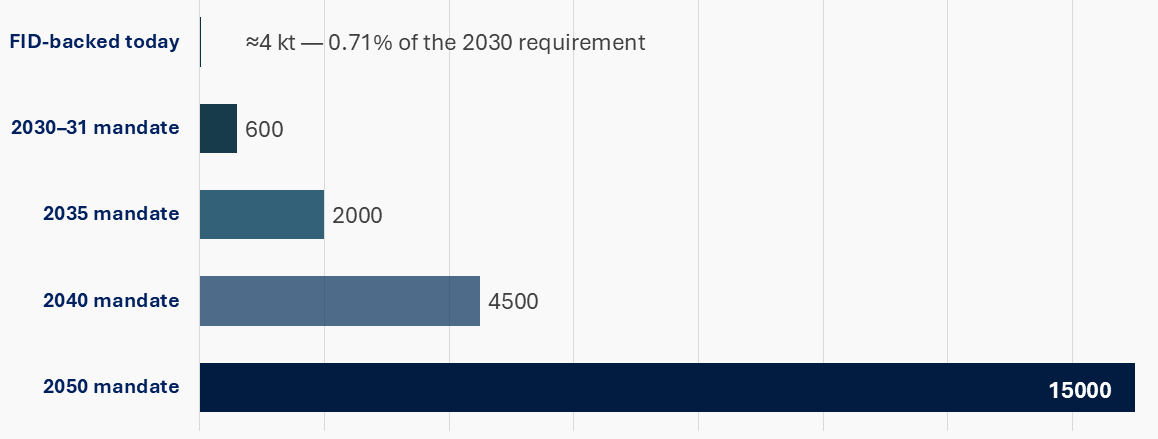
Annual Synthetic Aviation Fuel Volumes Implied by the ReFuelEU Sub-mandate (Thousand Tonnes per Year)
The mechanism failure here is worth naming precisely, because it is a design fault rather than a market failure. The obligated party under ReFuelEU is the fuel supplier. The party that ultimately pays a penalty is the airline, through pass-through. A fuel supplier can therefore satisfy its shareholders without ever signing an offtake contract, because the cost of non-compliance is recoverable. Incumbent suppliers also control the pipelines, terminals and hydrant systems between refinery and wingtip, which means a new entrant with molecules still needs their cooperation to deliver them. The mandate creates an obligation but not a procurement function, and no plant has ever been financed against an obligation.
The Cost Stack and Number
Production costs for first-of-a-kind European power-to-liquid plants sit in the range of €6,000–8,000 per tonne, falling towards €4,000 for larger nth-of-a-kind facilities with cheaper contracted power. Fossil jet fuel was priced around €750 per tonne before the recent oil disruption, roughly €830 including EU allowances. Bio-SAF sat near €2,000.
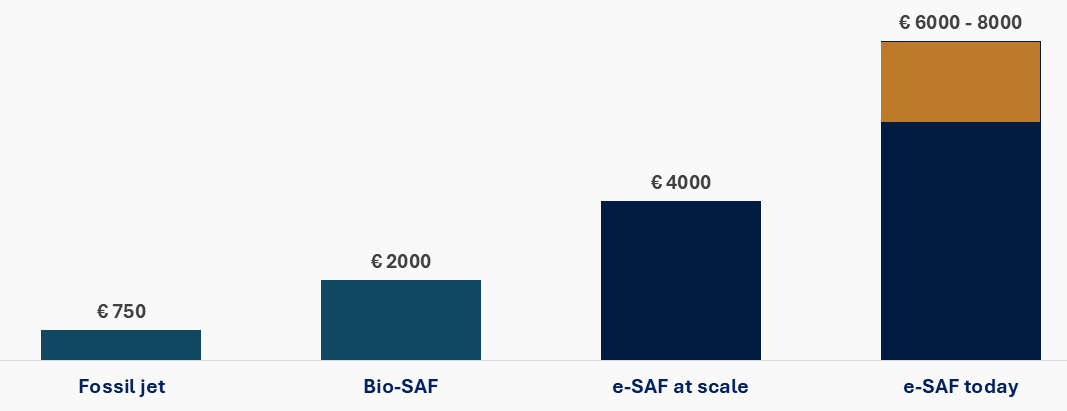
Delivered Cost per Tonne of Fuel (Indicative European values, euros per tonne)
The number that governs project viability is 40 megawatt-hours of electricity per tonne of product. A 100,000 tonne per year plant needs roughly 4 terawatt-hours a year, which is a mid-sized national industrial load. At that intensity, a €10 per megawatt-hour difference in contracted power price moves the cost of the product by about €400 per tonne. No amount of electrolyzer cost reduction compensates for a bad power contract, and no plant survives low utilization, because capital charges on a €1–2 billion facility are spread across whatever volume the plant actually makes.
Project location is decided by the price of firmed low-carbon electricity, not by proximity to the demand centre. Europe legislated the demand but the cheapest molecules will be produced elsewhere unless a revenue-certainty mechanism closes the delta. This is precisely why the argument in Brussels has shifted from climate policy to industrial sovereignty, and why five European developers launched a coalition in June 2026 framing synthetic aviation fuel as an energy-security and defense-readiness question rather than an environmental one.
The Abatement-Cost
Treasury departments and finance ministries evaluate this sector on cost per tonne of carbon dioxide avoided, and on that metric synthetic fuels look indefensible. Replacing roughly €1,000 per tonne fossil jet fuel with €6,000 per tonne e-SAF implies an abatement cost near €1,000 per tonne of CO₂, against EU allowance prices of €70–100 and 2030 projections of €150–200.
The defensible case rests on four other grounds: technology-forcing to create a market that would not otherwise exist, industrial policy to build domestic power-to-liquid capability, energy security through domestically synthesized liquid fuel, and the simple fact that long-haul aviation and deep-sea shipping have no electrification pathway this side of 2050. Clients who bring the carbon-price argument to a finance ministry get refused. Clients who bring the sovereignty and industrial-capability argument are now being heard, which is a material change in the last twelve months.
The Funded Projects
Infinium’s Project Roadrunner in Pecos, Texas took FID in May 2025 for roughly 23,000 tonnes a year of e-SAF and other synthetic products, with a 100 MW proton-exchange-membrane electrolyzer plant, equity from Brookfield and Breakthrough Energy Catalyst, project financing arranged with HSBC in June 2025, and long-dated offtake with American Airlines and IAG. In Denmark, the Kassø e-methanol facility developed by European Energy with Mitsui entered commercial operation in 2025 at 42,000 tonnes a year, with demand secured from Maersk, LEGO and Novo Nordisk.
In both cases the offtaker is a corporate buyer with a balance sheet and a reason to care, not a fuel supplier discharging a regulatory obligation. Infinium extended the pattern in 2026 when Project Atlas was selected through the Sustainable Aviation Buyers Alliance procurement, submitted jointly with American Airlines, which aggregates corporate travel and freight emissions demand into forward commitments long enough to support project finance.
|
Project or Transaction |
Structure |
Status and significance |
| Project Roadrunner, Texas | Infinium, with Brookfield and Breakthrough Energy Catalyst; HSBC debt | FID May 2025, ~23 kt/yr, production due 2027. Offtake with American Airlines and IAG, with volumes routed to the UK SAF mandate. |
| Kassø, Denmark | European Energy and Mitsui | Commercial operation from 2025, 42 kt/yr e-methanol. Buyers include Maersk, LEGO and Novo Nordisk. |
| Brandenburg eSAF, Schwedt | ENERTRAG with ZAFFRA, itself a Topsoe–Sasol joint venture; biogenic CO₂ from LEIPA | €350m federal and state grant awarded May 2026 against total investment above €500m. Engineering under way, FID targeted end-2027, production from 2030. |
| Turbe, Port of Rotterdam | Metafuels with Evos terminal; Dutch government grant | Methanol-to-jet route, first phase 10 tonnes per day, first fuel targeted for 2030 to meet the sub-mandate. |
| Norsk e-Fuel | Boeing equity investment, expanded 2026; MoU with Outokumpu for a carbon-monoxide-to-SAF plant at Tornio | Feasibility work through 2026, investment decision indicated around 2028, production from 2032. |
| Project ENDOR, Vordingborg | Arcadia eFuels; selected for a Green Finance Institute financing accelerator in 2026 | FEED complete for roughly 80 kt/yr, awaiting FID. The stated purpose of the accelerator is to build a de-risking template the wider European pipeline can reuse. |
| European eSAF Coalition | Arcadia eFuels, INERATEC, Norsk e-Fuel, SkyNRG and ZAFFRA | Launched June 2026 to position synthetic aviation fuel as strategic infrastructure for energy security and defense readiness. |
Two structural observations follow. First, the corporate form that is winning is the technology joint venture rather than the merchant fuel producer. ZAFFRA pairs Topsoe’s process technology with Sasol’s Fischer-Tropsch operating history and licenses that capability into projects developed by others. That is an asset-light way to capture value from a sector where the assets themselves are hard to finance. Second, the pre-FID pipeline is becoming an acquisition market in its own right. Development portfolios have started changing hands, and any group holding permits, grid connections and CO₂ supply agreements owns something scarcer than a technology licence.
Carbon Dioxide: The Binding Contract
Most commentary treats hydrogen as the constraint. In practice, each tonne of synthetic fuel needs roughly 0.7 tonnes of hydrogen and around 5 tonnes of carbon dioxide under industrial conditions. Hydrogen can be manufactured anywhere there is power and water. Qualifying carbon dioxide cannot. Biogenic sources that satisfy EU criteria are concentrated in pulp and paper, biogas upgrading, waste-to-energy and specific metallurgical off-gases, and they are being contracted now.
The Schwedt project is anchored on biogenic CO₂ from a paper manufacturer. The Norsk e-Fuel arrangement with Outokumpu is built on carbon-bearing side streams from a stainless steel mill. HIF Global signed an implementation agreement for biogenic CO₂ supply for its planned Uruguayan facility. Direct air capture remains the only unconstrained long-term source and remains the most expensive. For industrial groups that emit qualifying biogenic carbon dioxide, this is a live commercial question that most have not yet priced: a waste stream is turning into a contracted feedstock with a scarcity premium, and the counterparties signing those agreements today are locking in twenty-year positions.
Road Transport Reopens in November
The European Commission published its review of car CO₂ standards on 16 December 2025. The proposal replaces the 2035 zero-tailpipe requirement with a 90% reduction, allowing the residual 10% to be compensated through EU-made low-carbon steel or through renewable and low-carbon fuels placed on the market. Transport & Environment’s assessment is that full use of the flexibilities lands battery-electric sales near 85% in 2035 rather than 100%.
Road transport will not be the demand anchor for synthetic fuels regardless of how that vote lands. A crediting mechanism generates compliance value for carmakers; it does not generate a decade-long take-or-pay contract for a fuel plant. Aviation and shipping remain the only sectors where the obligation attaches to volume rather than to a fleet average. Boards positioning around the November vote should treat it as a signal about political direction and a source of incremental revenue, not as the foundation of an investment case.
China’s Role in e-SAF
The competitive picture has changed faster than the European policy debate has absorbed. Analysts tracking the renewable methanol sector estimated in June 2026 that more than three million tonnes of biomethanol and e-methanol capacity was under construction in China. Jiaze New Energy broke ground in April 2026 on a facility in Heilongjiang with total investment near half a billion dollars, producing 240,000 tonnes a year of green methanol with downstream conversion into e-SAF or ethanol. Vioneo, which had planned a fossil-free plastics plant in Antwerp, announced in January 2026 that its first commercial-scale facility would instead be built in China, close to green methanol supply. In August 2026 Sasol commissioned Envision Energy to run a design study for a green hydrogen system at Sasolburg, a notable direction of travel for technology sourcing.
The parallel with solar modules and lithium-ion cells is obvious and is being made explicitly by European analysts. China’s existing depth in methanol chemistry gives it a natural advantage on the methanol-to-jet route specifically. If European projects continue to miss FID while Chinese capacity is commissioned, the EU sub-mandate will be met by imports, and the industrial-policy justification for the mandate collapses while the cost remains.
Three Decisions Inside Twelve Months
This sector’s risk profile will be materially different by the middle of 2027, and for once the schedule is knowable.
-
-
- October 2026, London. The IMO reconvenes the extraordinary session that adjourned in October 2025 by 57 votes to 49. Adoption of the Net-Zero Framework would put a global fuel-intensity standard and a carbon price behind e-methanol and e-ammonia demand, with entry into force around 2028. A second failure leaves EU ETS and FuelEU Maritime as the only binding drivers and pushes global marine fuel demand out by years.
- November 2026, Brussels. The environment committee vote on car CO₂ standards sets the Parliament’s negotiating position on fuel crediting and on the treatment of vehicles running exclusively on carbon-neutral fuels.
- Through 2026 into 2027. The first pooled double-sided auction under the eSAF Early Movers Coalition, backed by eight member states aiming to mobilize at least €500 million, is the first real test of whether a government-backed intermediary can bridge the gap between what producers need and what airlines will pay. The Commission’s broader Sustainable Transport Investment Plan targets €2.9 billion of mobilised funding by 2027, against an estimated €100 billion needed by 2035 to meet the aviation and maritime fuel targets. A review of ReFuelEU is expected to follow.
-
In the United States the picture has already resolved, and not favourably for synthetic aviation fuel. The 2025 reconciliation act extended the 45Z clean fuel production credit through 2029 while cutting the maximum SAF credit from $1.75 to $1.00 per gallon, and proposed regulations issued on 3 February 2026 confirmed anti-stacking rules that prevent a facility from combining 45Z with the hydrogen and carbon-capture credits in the same year. American projects will be financed on corporate offtake and state-level low-carbon fuel programmes rather than on federal credit stacking.
What This Means for Six Sets of Decision-Makers
Positioning Implications by Stakeholder
|
Stakeholder |
The decision |
| Airlines and shipowners | Model the penalty-versus-offtake trade under scenarios where the sub-mandate holds, slips two years, or is restructured through an auction intermediary. Early forward commitments are currently the cheapest form of insurance against the penalty regime, and the buyers already in the market are securing volumes that will not be available later. |
| Fuel suppliers and refiners | Non-compliance is presently recoverable through pass-through. That position depends on national penalty regimes remaining untranslated and on infrastructure control remaining unchallenged. Both assumptions are under active political pressure, and expected penalties may yet be treated as balance-sheet liabilities. |
| Project developers | The scarce asset is a signed CO₂ supply agreement plus a grid connection plus a permitted site. Sequence your contracting to lock those before chasing technology differentiation, and structure to be acquirable by an industrial partner rather than to reach FID unaided. |
| Industrial CO₂ owners | Pulp and paper, cement, steel, waste-to-energy and biogas operators hold a feedstock whose scarcity value is rising. Do not sign a twenty-year supply agreement at a disposal-cost price. |
| Infrastructure and private capital | Project-on-project risk is the reason lenders are cautious: five first-of-a-kind components in series, each with independent completion risk. Diligence should focus on the interfaces and on utilization assumptions, not on the technology bricks individually. |
| Automotive and equipment OEMs | Treat the November vote as directional. Neither the Commission text nor the rapporteur’s draft creates the contracted volume that would justify vertical integration into fuel production. |