In the first hours of a major military operation in early 2026, an AI-powered targeting system generated over a thousand strike options with no human analyst writing a single line of intelligence. That moment marks a categorical threshold, not an incremental upgrade. The age of agentic defense has arrived, and organizations that fail to grasp its strategic implications will find themselves dangerously behind.
The Inflection Point: When Experimentation Became Deployment
For nearly a decade, artificial intelligence in defense lived in a carefully managed middle ground promising in the lab, compelling in demonstrations, but perpetually not yet ready for the realities of operational environments. That era is over.
The fiscal year 2026 defense budget marks a decisive turning point. For the first time in history, the Department of Defense carved out a dedicated budget line for autonomy and artificial intelligence allocating USD 13.4 billion specifically to AI and autonomous systems within an overall defense budget that crossed the trillion-dollar threshold. That figure alone exceeds the entire annual budget of NASA.
Simultaneously, active military programs once described as pilot projects have been quietly redesignated as mission-critical systems. The intellectual framework that defined AI as a force multiplier has been superseded by a new reality: AI is increasingly the primary intelligence layer ingesting data, generating options, and compressing decision cycles from hours to seconds.
“The sentiment among government technology leaders has shifted from ‘what is possible’ to ‘what can we operationalize.'”
– Senior Technology Executive, Federal Defense Sector
Organizations that move now building data infrastructure, governance frameworks, and human-machine teaming capabilities will capture significant competitive advantage. Those that wait for clearer policy guidance may wait too long.
The Market in Numbers: A Decade-Long, Multi-Trillion Dollar Mandate
Understanding the scale of this transformation requires moving beyond headline budgets to examine the structural forces driving sustained investment across every tier of the defense ecosystem.
The $13.4 billion dedicated AI and autonomy allocation breaks down across capability domains with telling specificity: unmanned and remotely operated aerial vehicles account for $9.4 billion, maritime autonomous systems receive $1.7 billion, underwater capabilities receive $734 million, and cross-domain software integration absorbs a further $1.2 billion. An additional $200 million is directed exclusively at AI and automation technology. These are not evenly distributed bets but they signal a clear doctrinal hierarchy that places aerial autonomy at the center of the modernization agenda.
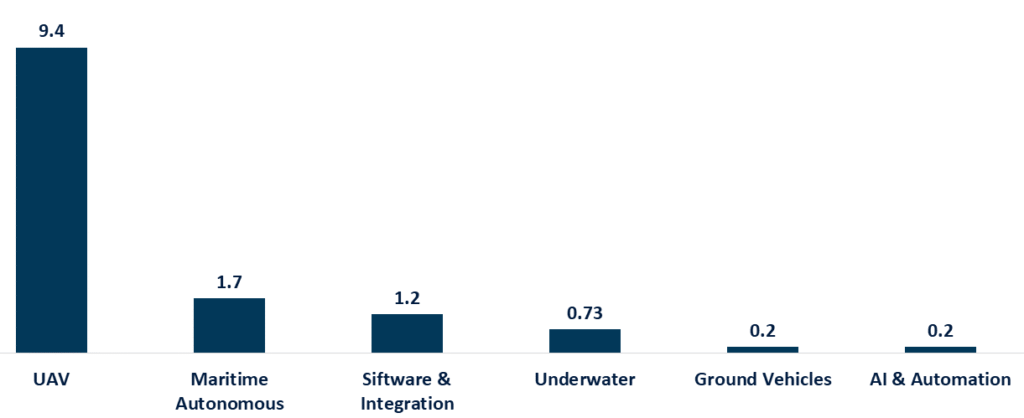
U.S. DoD FY2026 AI & Autonomy Budget Allocation ($13.4 Billion)
Globally, allied defense spending amplifies these figures dramatically. NATO’s estimated total defense expenditure crossed $1.4 trillion in 2025, with the alliance accelerating investment in digital command, control, and autonomous capabilities. European nations, responding to an altered security environment, are projected to raise collective defense spending toward 2.9% of GDP by 2030, a trajectory that implies several hundred billion euros in new capability investment, much of it oriented toward AI-enabled systems.
Asia-Pacific defense establishments are investing with similar urgency. China, India, Japan, and South Korea are each accelerating autonomous drone programs, AI-driven command systems, and intelligent ISR (Intelligence, Surveillance, Reconnaissance) platforms. It is a global restructuring of how military capability is built, maintained, and projected.
Understanding Agentic AI: Why This Technology Is Categorically Different
Much of the confusion in boardroom discussions of defense AI stems from conflating three distinct capability levels that demand different strategic responses.
Traditional AI recognizes and classifies. It processes images, flags anomalies, and surfaces recommendations. A human reviews the output and decides. This is the AI that most defense organizations have encountered in pilot form over the past decade.
Generative AI produces. It drafts, synthesizes, and creates text, code, simulation outputs, and intelligence summaries. It accelerates knowledge work and enables new forms of human-machine collaboration. Most enterprise AI deployments in 2024 and 2025 operated in this register.
Agentic AI acts. It plans multi-step tasks, executes across interconnected systems, monitors outcomes, adjusts in real time, and continues operating without human approval at each step. In a defense context, this means an AI that doesn’t just identify a logistics bottleneck but it reroutes supply chains, updates procurement orders, and refiles maintenance schedules while a human commander focuses on the operational picture.
The transition to agentic systems is particularly significant in defense because the environments where they operate are high-stakes, data-saturated, and time-compressed. A human analyst reviewing drone footage can process a fraction of what modern surveillance generates in a single sortie. An AI system doing the same work operates at machine speed and scale. The question is no longer whether to use AI for intelligence processing, but it is how to govern what the AI does once it has processed that intelligence.
By 2026, agentic AI is expected to move from pilot deployments to scaled operations across decision-making, procurement, logistics planning, predictive maintenance, and administrative functions within major defense organizations. The technology has crossed the threshold from capability demonstration to operational dependency.
From Experiment to Operational Backbone
Skepticism about defense AI often reflects familiarity with the sector’s well-documented history of ambitious programs that failed to survive contact with real-world operational requirements. The current generation of deployments is different, and the evidence merits careful attention.
The AI-enabled targeting and intelligence platform that underpins current U.S. military operations now counts over 20,000 active users, a figure that has quadrupled in the span of approximately eighteen months. It operates across more than 35 military services and combatant command software environments spanning three security classification levels. From its origins as a video analysis tool designed to reduce the burden on human imagery analysts, it has evolved into what defense officials now describe as the primary AI operating system of the U.S. military deployed in active conflict zones for targeting support, maritime threat identification, and geospatial intelligence.
By June 2026, the core AI intelligence system used by U.S. combatant commands is expected to transmit 100% machine-generated intelligence to commanders with no human hands involved in the template generation or dissemination workflow. This is not a future scenario. It is a scheduled operational transition.
The Global Race: Three Distinct Strategic Playbooks
Framing the AI defense landscape as solely a U.S. story misses the structural competition that is driving urgency at every level of the ecosystem. Three distinct strategic approaches are currently in play, and the gap between them is narrowing.
The United States holds the largest defense AI investment in history and has moved aggressively from research to operational deployment. The formation of a dedicated Barrier Removal Board to waive testing requirements that slow AI fielding illustrates the administration’s willingness to accept governance risk in exchange for deployment speed. The core doctrine is straightforward i.e. the cost of moving too slowly exceeds the cost of imperfect systems.
China’s approach centers on scale, swarm architecture, and supply chain control. The strategic logic is to field autonomous systems in volumes that overwhelm adversary defenses, leverage vertically integrated domestic production chains, and exploit dominance over rare earth elements and battery materials that are essential to both commercial and military AI hardware. Critically, China’s approach to AI governance in weapons development is permissive by design, an asymmetry that creates both a competitive challenge and an ethical risk differential that allied governments are actively managing.
Europe’s trajectory is shaped by a security environment that has materially changed since 2022. Defense budgets across the continent are growing at rates not seen in decades. Next-generation combat aircraft programs, each of which places AI at the center of the platform architecture, are advancing with new urgency.
For defense contractors, systems integrators, and allied governments, the strategic takeaway is consistent across all three playbooks: the window to establish foundational AI capabilities before the competitive landscape consolidates is narrowing rapidly.
Five Strategic Imperatives for Defense Organizations in 2026
The following framework distills the strategic implications of this analysis into five actionable priorities for defense organizations navigating the transition to AI-enabled operations. Each represents both an immediate operational requirement and a foundation for long-term competitive resilience.
1. Treat Data Modernization as the Prerequisite, Not the Parallel Track
Agentic AI performs at the level of the data it ingests. Organizations that attempt to layer AI onto fragmented, siloed, or poorly structured data environments will generate fast, confident, wrong outputs. The first investment must be in unified data architecture i.e. standardized ingestion pipelines, clean labeling workflows, and a single operational data environment that AI agents can reliably query and act upon. Defense programs that have succeeded at scale share one characteristic: they solved the data problem before the AI problem.
2. Design Human-Machine Teaming Protocols Before Deploying Autonomous Systems
The failure mode most observed in autonomous defense deployments is not technical, but it is doctrinal. Systems are deployed without clear protocols for when AI recommendations override, augment, or defer to human judgment. Organizations that define these boundaries in advance specifying which decisions require human authorization, which can be executed autonomously within defined parameters, and which trigger escalation consistently outperform those that attempt to establish governance after deployment.
3. Build AI Governance Architecture Now, While the Regulatory Environment Is Still Forming
The legislative and international regulatory environment around autonomous weapons and defense AI is in active formation. Organizations that invest now in accountability frameworks, audit trails, and explainability standards will be positioned to demonstrate compliance when requirements crystallize rather than facing costly retrofits. This is particularly critical for organizations with exposure to both U.S. and European regulatory environments, where divergent standards are emerging simultaneously.
4. Develop Multi-Vendor Resilience Strategies to Avoid Strategic Dependency
The consolidation of major AI defense capabilities into a small number of contractor platforms creates supply chain concentration risk at the program level. Organizations should evaluate their AI vendor landscape with the same portfolio discipline applied to hardware and munitions supply chains ensuring that critical AI capabilities are not dependent on a single commercial relationship that may shift due to policy, commercial, or geopolitical factors.
5. Pursue Allied Market Entry and International Partnership Now
The acquisition of U.S.-developed AI intelligence platforms by allied military organizations in 2025 marks the opening of a substantial international market. Defense firms with established AI capabilities should be actively developing allied government partnership strategies, with particular attention to European markets where defense spending growth is fastest, procurement urgency is highest, and interoperability with U.S. systems is a stated requirement. First-mover relationships in this environment carry compounding advantages.