Executive Summary
In an era where digital assets are reshaping portfolio diversification strategies, the global crypto exchange-traded fund (ETF) market stands at a pivotal inflection point. As of October 2025, assets under management (AUM) in crypto ETFs have surpassed $180 billion worldwide, driven by regulatory breakthroughs in the United States and sustained institutional appetite in Europe and Asia. BlackRock’s iShares Bitcoin Trust (IBIT) reported net assets of $89.66 billion. Fidelity’s FBTC and Grayscale’s GBTC are among the next largest, with FBTC at ~$25.09 billion and GBTC ~$19.45 billion in AUM.
The emergence of Crypto Asset Exchange-Traded Funds (ETFs) represents a critical inflection point in the maturation of digital assets. No longer a niche for retail speculators, the launch of these regulated investment vehicles signals a profound shift towards institutionalization. The data indicates that while North America currently leads in scale, the global market is evolving rapidly, presenting both significant opportunities and complex strategic considerations.
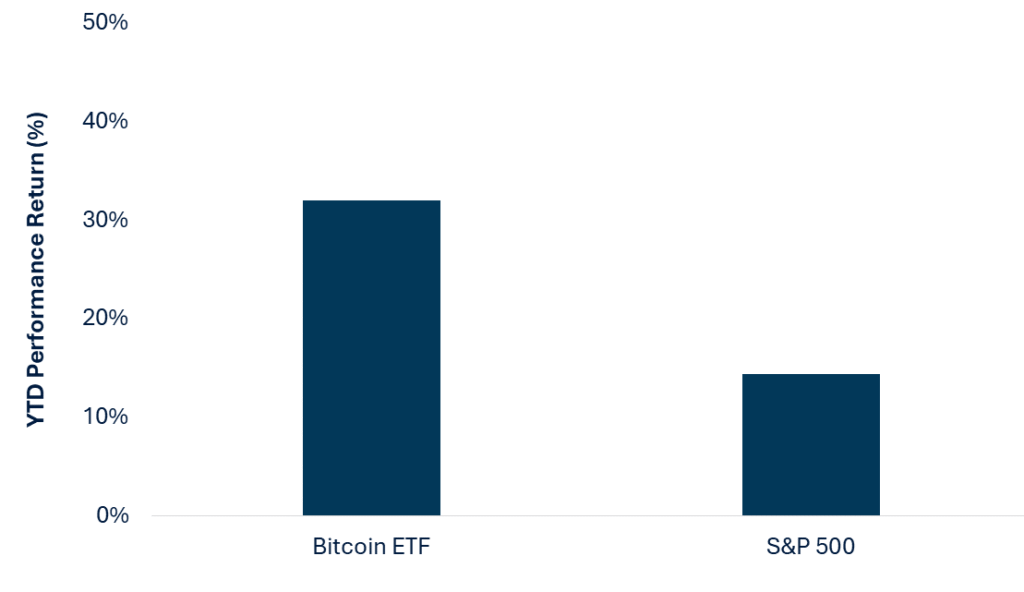
YTD Performance: Bitcoin ETFs vs S&P 500 (October 2025)
The Paradigm Shift: From Direct Ownership to Regulated Exposure
The fundamental value proposition of a crypto ETF is its ability to demystify and derisk access to digital assets. Instead of navigating unregulated exchanges, managing private keys, and confronting security concerns, investors can now gain exposure through a familiar, transparent, and liquid instrument traded on established stock exchanges. This structural innovation has been the single greatest catalyst for institutional capital allocation to the asset class.
Globally, bitcoin ETFs dominate the total crypto ETF universe with over 80% of share. This dominance reflects the maturation of spot-based products, which have democratized access to cryptocurrencies without the operational complexities of direct custody. From a regional lens, United States commands over 85% market share, with over $140 billion in AUM reported. Europe, bolstered by the Markets in Crypto-Assets (MiCA) framework, holds a 10% slice, while Asia-Pacific trails at 4%, constrained yet by fragmented regulations.
This fragmentation signals opportunity: As MiCA’s custody licensing takes full effect in Europe by late 2025, cross-border flows could accelerate, potentially elevating EMEA’s share to 15% by year-end. In Asia, ongoing shift in Hong Kong and Singapore on digital asset ETPs could unlock $5-10 billion in new AUM, per regional policy analyses. For institutional clients, this underscores the imperative to diversify geographically, mitigating U.S.-centric risks such as policy reversals.
Regulatory Tailwinds: A Catalyst for Convergence
Regulatory clarity has been the linchpin of the crypto ETF surge. In September 2025, the SEC’s approval of generic listing standards for commodity-based ETPs marked a seismic shift, streamlining approvals from case-by-case scrutiny to expedited reviews, slashing timelines from 240 days to mere weeks. This has paved the way for 16 pending spot altcoin ETFs, including Solana and XRP variants, with decisions anticipated in Q4.
Globally, harmonization is gaining traction. Europe’s MiCA regulation, fully operational since June 2024, has fostered a stable environment for ETPs, evidenced by Germany’s $312 million weekly inflows in early October. In Asia, Japan’s Financial Services Agency expanded tokenized asset guidelines in Q2 2025, while Singapore’s Monetary Authority greenlit two new ether ETPs, signaling a pivot toward innovation-led oversight. These developments reduce tail risks for investors, enabling scalable allocations yet they also amplify competition, pressuring fee compression from current averages of 0.94% to sub-0.5%.
|
Region |
Regulatory Stance | Key Product Types | Approximate AUM (Spot Focus) |
Market Characteristic |
|
United States |
Approved (Spot, Jan ’24) |
Spot Bitcoin ETFs, Futures ETFs | >$58 Billion (Spot Bitcoin) |
High Liquidity, Dominant Scale |
|
Canada |
Early Adopter |
Spot Bitcoin/Ethereum ETFs | ~$5 Billion |
Established, Mature Market |
|
Europe |
Permissive (Fragmented) |
ETPs, ETNs (Swiss, German) | ~$10 Billion |
Fragmented, Diversified |
|
Hong Kong |
Recently Approved |
Spot Bitcoin & Ethereum ETFs | <$1 Billion |
Nascent, Strategic Hub |
|
Japan / S. Korea |
Cautious / Restrictive |
Futures-based only (limited) | Minimal |
Regulatory Scrutiny High |
Strategic Implications for Institutional Portfolios
The integration of crypto ETFs is no longer a speculative debate but a concrete portfolio management consideration.
-
-
- Inflation Hedge and Diversification: Despite volatility, Bitcoin has demonstrated a low-to-negative correlation with traditional asset classes like equities and bonds over certain periods. Allocating a small percentage (1-3%) can potentially enhance portfolio Sharpe ratios through diversification, a thesis supported by analysis from firms like Fidelity Investments.
- Operational Efficiency: ETFs eliminate the operational burdens of direct custody, insurance, and compliance. This allows pension funds, endowments, and corporations to gain exposure through their existing brokerage and custodial relationships.
- The Coming Wave of Ethereum and Beyond: The market’s focus is now shifting to the potential approval of spot Ethereum ETFs in the U.S., which would provide regulated access to the native asset of the decentralized finance (DeFi) ecosystem. This could unlock a new, more complex layer of digital asset investment.
-
Forward Outlook and Strategic Recommendations
The crypto ETF market is at an early, yet rapidly accelerating, stage of its lifecycle. We anticipate the following developments:
-
-
- Product Proliferation: The success of single-asset Bitcoin ETFs will pave the way for multi-asset crypto baskets, thematic ETFs (e.g., DeFi, Smart Contract Platforms), and eventually, actively managed crypto ETFs.
- Deepening Global Integration: As more jurisdictions establish clear regulatory frameworks, cross-border investment flows will increase, leading to greater market efficiency and liquidity.
- Enhanced Scrutiny and Standardization: With growth will come intensified regulatory focus on governance, underlying asset custody (the “physical” vs. “synthetic” debate), and ESG reporting.
-
Conclusion
The launch and explosive growth of crypto ETFs mark the unequivocal arrival of digital assets as a legitimate institutional asset class. This is not a transient trend but a structural evolution of the global financial system. The divergence in global regulatory approaches creates a complex but navigable landscape.
For forward-looking organizations, the strategic imperative is not if to engage, but how to strategically integrate these instruments into a modern, diversified, and future-proof investment framework. The era of crypto institutionalization is here, and it is traded on an exchange.
Our strategic recommendations are as follows:
-
-
- For Asset Managers: Develop a clear product roadmap for the next wave of crypto ETFs beyond Bitcoin. Partnering with established, regulated custodians is non-negotiable for building investor trust.
- For Institutional Investors: Conduct a thorough due diligence process, focusing not just on the ETF issuer but, critically, on the underlying custody solution and the tracking methodology of the fund.
- For Corporate Strategists: Monitor the maturation of this market as a potential avenue for corporate treasury diversification, following the lead of several publicly traded companies.
-
Navigate the future of finance with confidence – connect with our advisory team to craft your tailored crypto ETF strategy.